


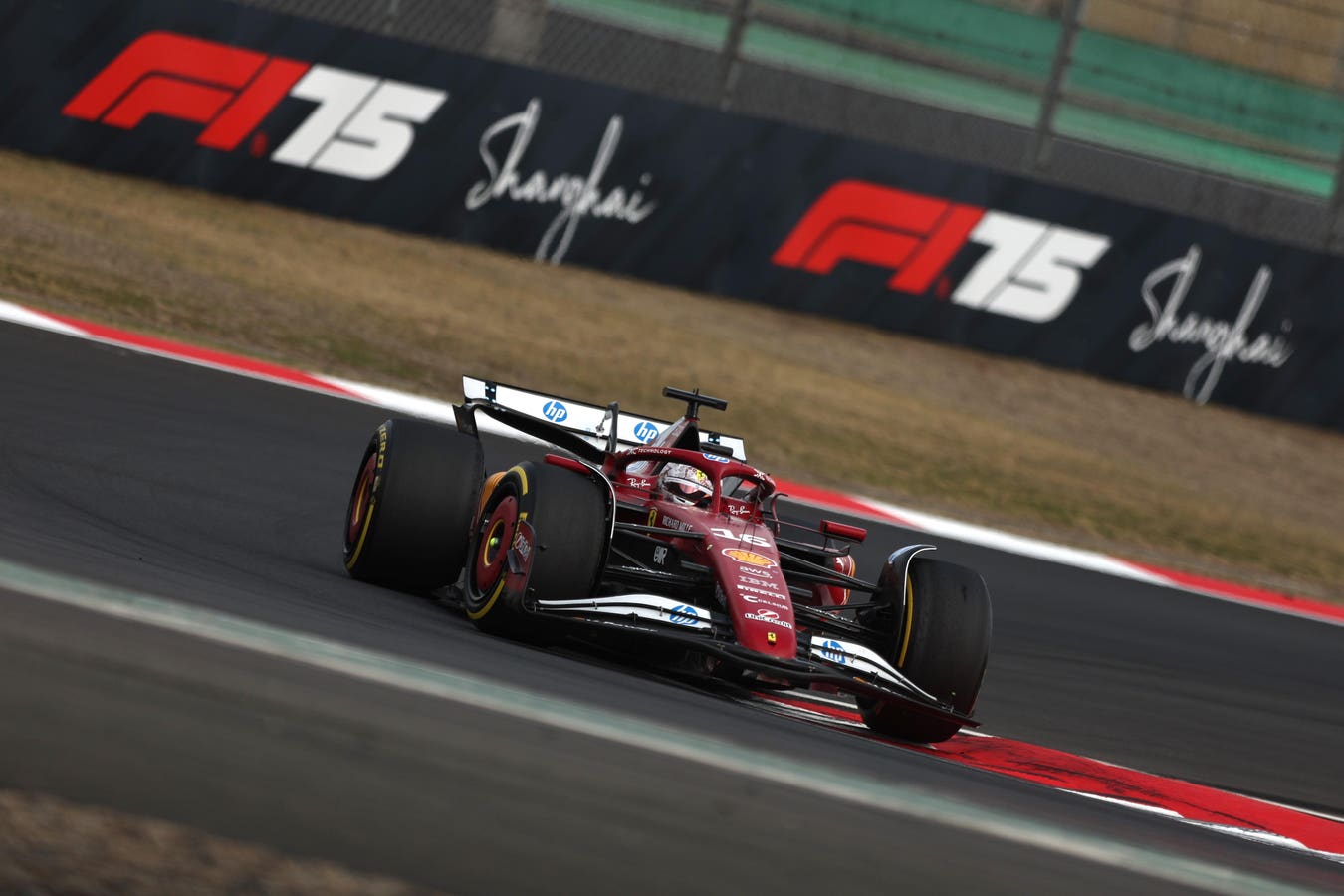
SHANGHAI, CHINA – MARCH 23: Charles Leclerc of Monaco driving the (16) Scuderia Ferrari SF-25 on … More
Charles Leclerc and Pierre Gasly have both faced disqualification from the 2025 Chinese Grand Prix after their Ferrari and Alpine cars were found to be underweight during post-race checks.
Leclerc crossed the finish line in fifth place, while Gasly missed out on scoring Alpine’s first point of the season, ending up in 11th behind Oliver Bearman of Haas.
Following the race, both drivers were summoned by the stewards for alleged breaches of Article 4.1 of the Technical Regulations. According to the FIA report, Leclerc’s Ferrari weighed exactly 800kg after returning to the pits — the minimum weight mandated by the regulations excluding fuel.
However, as his car’s front wing sustained damage in an early contact with teammate Lewis Hamilton, the SF-25 car was re-weighed with the retrieved endplate and a spare front wing, bringing the total weight to 800.5kg.
When two liters of fuel were later drained from the car, the weight dropped to 799kg, just below the minimum.
“After the race, car number 16 was weighed and its weight was 800.0kg, which is the minimum weight required by TR Article 4.1.,” said FIA technical delegate Jo Bauer.
“As the front wing was damaged (the missing FW endplate was recovered and weighed with the car), the car was re-weighed with an official spare front wing assembly of car 16 and its weight was 800.5kg. After this, fuel was drained out of the car and 2.0 litres of fuel were removed.
“The car was weighed again on the FIA scales (with the official spare front wing assembly of car 16) and the weight was 799.0kg. The calibration of the scales was confirmed and witnessed by the competitor. For information the spare front wing was 0.2kg heavier than the damaged one used during the race. As this is 1.0kg below the minimum weight requested in TR Article 4.1, which also has to be respected at all times during the competition, I am referring this matter to the stewards for their consideration.”
Similarly, Gasly’s car also registered at 800kg during its first weight check. After removing 1.1kg of fuel according to Alpine’s draining procedure, his car was left at 799kg. Therefore, the stewards disqualified both drivers, stripping them of their race results.
In Shanghai, China, on March 21, 2025, Lewis Hamilton of Great Britain and Scuderia Ferrari and … More
To add to Ferrari’s woes, Hamilton was also disqualified from sixth as the rear skid block on his car failed to meet the minimum thickness requirement – a bitter pill to swallow for the Brit who had secured his first victory for the team in the sprint earlier in the weekend.
The Scuderia’s double disqualification means that Esteban Ocon, Kimi Antonelli, Alex Albon, and Oliver Bearman were promoted by two positions, while Lance Stroll and Carlos Sainz also benefited by moving into the top ten thanks to Gasly’s disqualification from 11th.
F1 Car Weight Rule In 2025
The minimum weight of a Formula 1 car has changed significantly over the years, having increased from 585kg in 2008 to 798kg in 2022 – including a minimum driver weight of 80kg and excluding fuel.
This weight limit remained the same for the 2023 and 2024 seasons, but for the 2025 season, it has risen to 800kg (including driver, excluding fuel), allowing drivers to weigh up to 82kg, which accounts for their body weight along with gear like helmets and race suits.
Article 4.1 of the Technical Regulations reads, “The mass of the car, without fuel, must not be less than 800kg plus the Heat Hazard Mass Increase (defined in Article 4.7), at any time during the Competition.”
While there is no maximum weight limit, teams try to be as close to the minimum as possible to optimize performance. If a car is found to be below 800kg, teams can add ballast to meet the required weight. Similarly, if a driver weighs under the minimum weight, ballast can also be used to compensate.
Failure to comply with the minimum weight rule normally leads to a slam dunk disqualification, just as it did for Leclerc and Gasly in China.
A similar incident also occurred during the 2024 Belgian Grand Prix when George Russell’s Mercedes was found to be underweight, costing him a race win and promoting Hamilton to victory.
In 2026, the sport is set to undergo significant regulatory changes aimed at improving the quality of racing and increasing overtaking opportunities.
The new regulations will require cars to be narrower, shorter, and lighter than in recent seasons, with the minimum F1 car weight dropping by 30kg to a total of 768kg. This will consist of 722kg for the car and driver, plus an estimated 46kg for the tires.
