


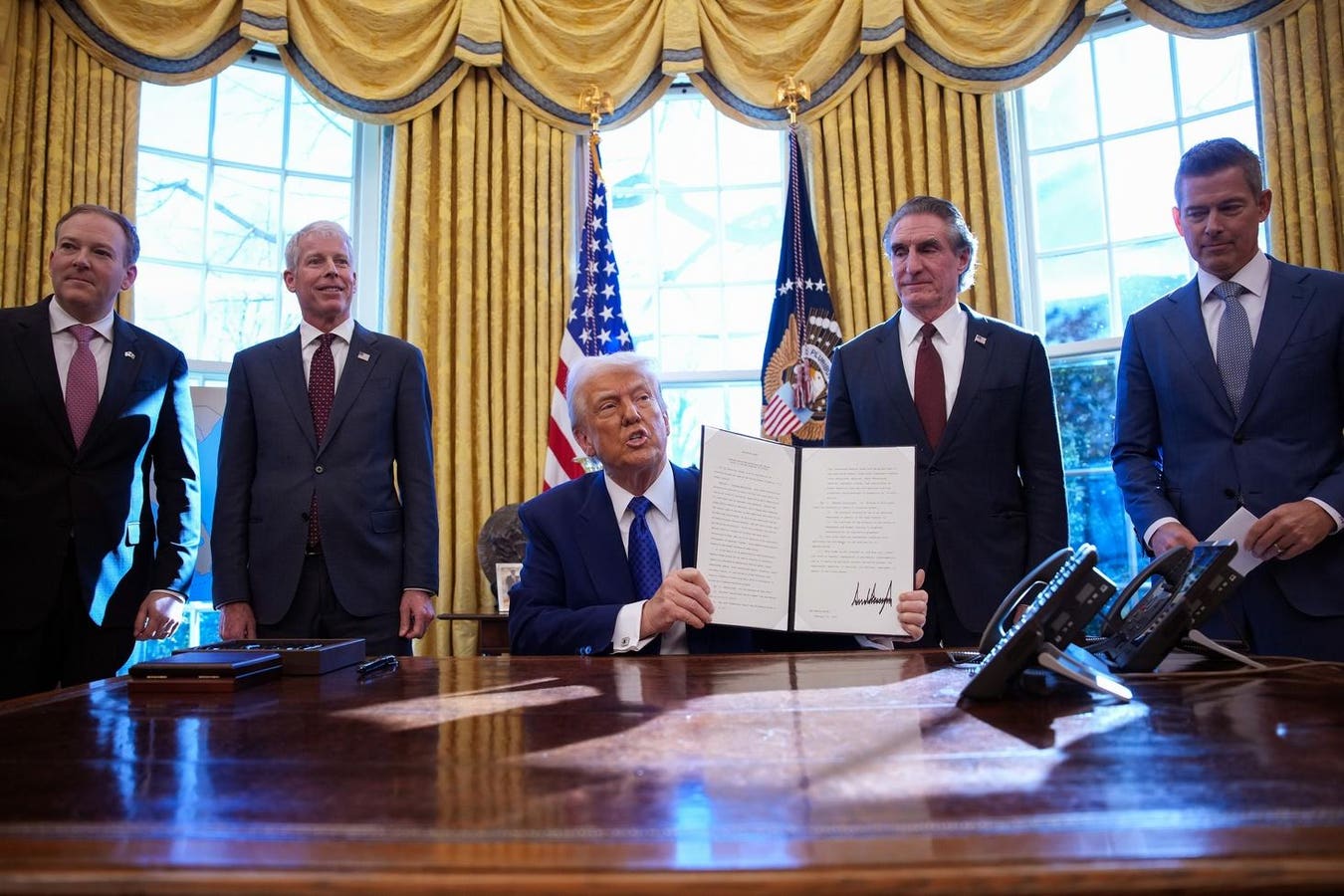
WASHINGTON, DC – FEBRUARY 14: U.S. President Donald Trump signs an executive in the Oval Office at … More
As is the case every year, statements by major players in the global energy space out of the annual CERAWeek conference held in Houston dominated the news last week. Most years, the various speeches, presentations, panel discussions, and sideline interviews held during the event provide a picture of the oil and gas industry’s overarching outlook for the rest of the year to come. This year was no exception, and, despite the Trump agenda calling for an era of “American Energy Dominance,” it wasn’t what many had expected.
There is little question that the domestic U.S. industry stands to benefit from the radical shift in policy direction taking place in the federal government today. The past four years of companies both large and small having to try to absorb and comply with a withering flood of new regulatory actions targeting their industry each month are over, now replaced by an agenda to rewrite many of the Biden-era rules and roll back others using the Congressional Review Act and other tools. Gone also will be intentional interminable delays in permitting and cancellations of lease sales mandated by statute as the Trump administration moves to aggressively implement its “American Energy Dominance” agenda.
The Trump Agenda Is Driving Positive Change
President Donald Trump lifted Joe Biden’s ill-considered “pause” in permitting for LNG infrastructure as one of his dozens of Day-One actions. Already, his Department of Energy has issued go-ahead permits to five new LNG export facility projects, including Wednesday’s permit issued to Venture Global to move forward with plans to expand its Cameron LNG facility in South Louisiana.
Speaking at CERAWeek, Energy Secretary Chris Wright promised the administration would seek to dismantle the entire Biden energy policy agenda, saying, “The Trump administration will end the Biden administration’s irrational, quasi-religious policies on climate change that imposed endless sacrifices on our citizens.”
Noting that natural gas currently supplies 43% of power generation in the nation’s electric grid, Wright added, in his view, there “is simply no physical way that wind, solar and batteries could replace the myriad uses of natural gas.”
In his own comments at CERAWeek, Interior Secretary Doug Burgum said he believes the Trump Administration will be able to rescind or rewrite 20% to 30% of regulations on the industry, including a higher percentage of the Biden agenda. Burgum also promised that speeding up permitting for oil and gas drilling and minerals mining projects will be a focus of the administration’s new National Energy Dominance Commission, of which he serves as chairman.
Doug Burgum, US secretary of the interior, speaks during the CERAWeek by S&P Global conference in … More
Though not speaking at CERAWeek itself, EPA Administrator Lee Zeldin made big news on the conference’s third day when he promised in a video to seek to reverse the agency’s 2009 endangerment finding related to greenhouse gases. A successful reversal of that finding would place almost every element of both the Biden and Obama-era energy and climate policy agenda at risk.
Momentum has even seemed to shift in the area of litigation, where industry defendants have prevailed in a number of recent decisions in lawsuits brought by cities, counties, and states seeking billions in damage awards alleging nebulous damages due to greenhouse gas emissions.
Most recently, a nine-person jury in North Dakota stunned energy companies and activist groups alike by ordering the anti-fossil fuels group Greenpeace to pay a whopping $667 million to Energy Transfer in a defamation case related to its development of the Dakota Access Pipeline. Senior officials at Greenpeace warn that the verdict in the case, if not reversed on appeal, could force the bankruptcy and closure of its U.S. operations. The Washington Post quotes Michael Gerrard, director of the Sabin Center for Climate Change Law at Columbia University, as warning that the verdict “sends a chilling message to physical climate protests — anything that actually disrupts fossil fuel production.”
Even Al Gore seemed to recognize the accelerating collapse in the Biden agenda and the energy transition in general in an op/ed this week in the Wall Street Journal, titled, “The Business Case For Green Energy.” In that piece, Gore begins by acknowledging recent pullbacks from the energy transition agenda by governments and an array of private entities alike and then goes onto argue the case for ongoing increases in private investments in alternative energy sources.
So, with the Trump Energy Dominance agenda driving all this and more positive change in the industry’s favor, you might have expected oil and gas executives to arrive at CERAWeek with a uniformly positive outlook for the future. There, you would have been wrong.
The Other Side Of The Trump Agenda Coin
Here, it is important to understand the other side of the Trump agenda, which is to dramatically lower prices for oil, natural gas, and all other energy sources in order to help drive down inflation and provide a boost to consumer spending. Simply put: You can’t get to “drill, baby, drill” if commodity prices drop by 30% to 40% from current levels, which is Trump’s stated target.
Scott Sheffield, chief executive officer of Pioneer Natural Resources Co., speaks during the 2023 … More
“It’s really hard to make money at $50 oil,” Scott Sheffield, former CEO at Permian Basin giant Pioneer Natural Resources, said in an interview with Bloomberg Television on the sidelines at the gathering. “You’ve really got to hunker down. You may have to lay off some people. You’ve got to focus on your best prospects. We’ll see what happens over the next two or three years.”
There is also a growing concern among many in the shale sector that the inventory of Class 1 drilling projects is depleted, meaning overall production from the Permian Basin and other major shale plays around the country could peak in the near future. It is fair to point out here that some in the U.S. shale industry have expressed such concerns since at least 2017, when total U.S. oil production averaged about 9.5 million barrels per day (bpd), according to the U.S. Energy Information Administration (EIA). EIA says the industry is currently producing about 13.5 million bpd, an indicator of the industry’s longtime ability to surprise its pessimists to the upside.
Still, those current production levels have been achieved during a period when domestic U.S. oil prices have hovered in the range of $70 per barrel or higher. A drop to the Trump target of $50/bbl would likely put an end to ongoing increases in overall production, and potentially even result in a gradual decline. That would definitely not be part of any Energy Dominance agenda.
The Bottom Line For The Trump Agenda
No one should doubt that most in the oil and gas business view the change in administrations from the Green New Dealism of Joe Biden to the American Energy Dominance of Donald Trump as highly positive for their industry. At the same time, though, it would be a mistake to think there are no downsides to that transition.
Four years ago, most companies in the shale business could remain profitable at a $50/bbl oil price. But four years of rapid inflation, high interest rates, and heavy-handed federal regulatory actions has changed that profit picture. The Trump Agenda goal of dramatically lower prices for oil and gas leaves shale producers facing a very uncertain future indeed.
