(Bloomberg) — Asian stocks stumbled on Friday, in the wake of ominous signals from US corporate earnings and a series of central bank meetings that only served to highlight the many questions hanging over the global economy.
Most Read from Bloomberg
Hong Kong shares faced heavy selling pressure, with a gauge of technology stocks in the city sliding close to 4% at one point after a recent rally. A broader index of Chinese stocks listed in the financial hub declined for a third day. Shares in Indonesia and Taiwan also fell, while those in Japan fluctuated.
The Euro Stoxx futures pointed to a downbeat open, with their US peers also marginally lower. A dollar index rose slightly while Treasuries were steady.
Investors are confronting an increasingly cloudy outlook for the global economy, as tariff fears and corporate earnings weigh on sentiment. US President Donald Trump said both broad reciprocal tariffs and certain additional sector-specific tariffs would come into force on April 2, a major risk for the global economy.
“You’ve seen President Trump’s policies inject the market with a wave of uncertainty that we’ve not seen for many years,” said Todd Jablonski, global head of multi-asset and quantitative investments at Principal Asset Management, on Bloomberg Television. The firm has dialed back risk in multi-asset portfolios, he said.
Shares of FedEx Corp. — considered an economic barometer — sank after the firm cut its profit outlook given higher costs and signs of weakening demand. Nike Inc. also cited the tariffs and geopolitics tensions as factors that will impact its earnings.
Investors are now turning their attention to a raft of upcoming earnings from Chinese companies, with bellwethers Xiaomi Corp., Tencent Holdings Ltd. and e-commerce giant Meituan among those set to report. US-listed shares of PDD Holdings Inc. rose after its earnings beat expectations, but the company acknowledged challenges from growing global uncertainty.
Central Bank Signals
Central bankers at the the Federal Reserve, the Bank of Japan and the Bank of England this week all pointed to the tariffs as obscuring their outlook on the economy, and impeding their policy making.
The European Union this week delayed a proposed tariff on American whiskey. The trading bloc is ready to talk to Trump before making further decisions on retaliatory tariffs, Ireland’s deputy prime minister said.
The yen weakened after consumer inflation slowed. The pound lost more ground after the Bank of England voted to stand pat on rates, while the euro also slid.
“I think we are seeing a bit of consolidation in the euro as traders digest the Fed update as well as the impact of the EU contribution to the Ukraine defense,” said Nick Twidale, chief analyst at AT Global Markets in Sydney. “The euro needs another positive catalyst to push it higher in the next couple of sessions.”
At a summit in Brussels, European Union leaders tussled over weapons deliveries to Kyiv and who would represent them in US-led diplomacy as the bloc struggled to formulate a strategy on Ukraine.
Weakness on Wall Street also comes ahead of a big test later Friday when $4.5 trillion of options contracts expire in an event known as triple witching that often stokes volatility.
“We will go up and down as policy uncertainty continues,” Michael Rosen, chief investment officer at Angeles Investments, said in an interview at Bloomberg headquarters in New York. “Investor sentiment is going to be very volatile, and that will be reflected in the market.”
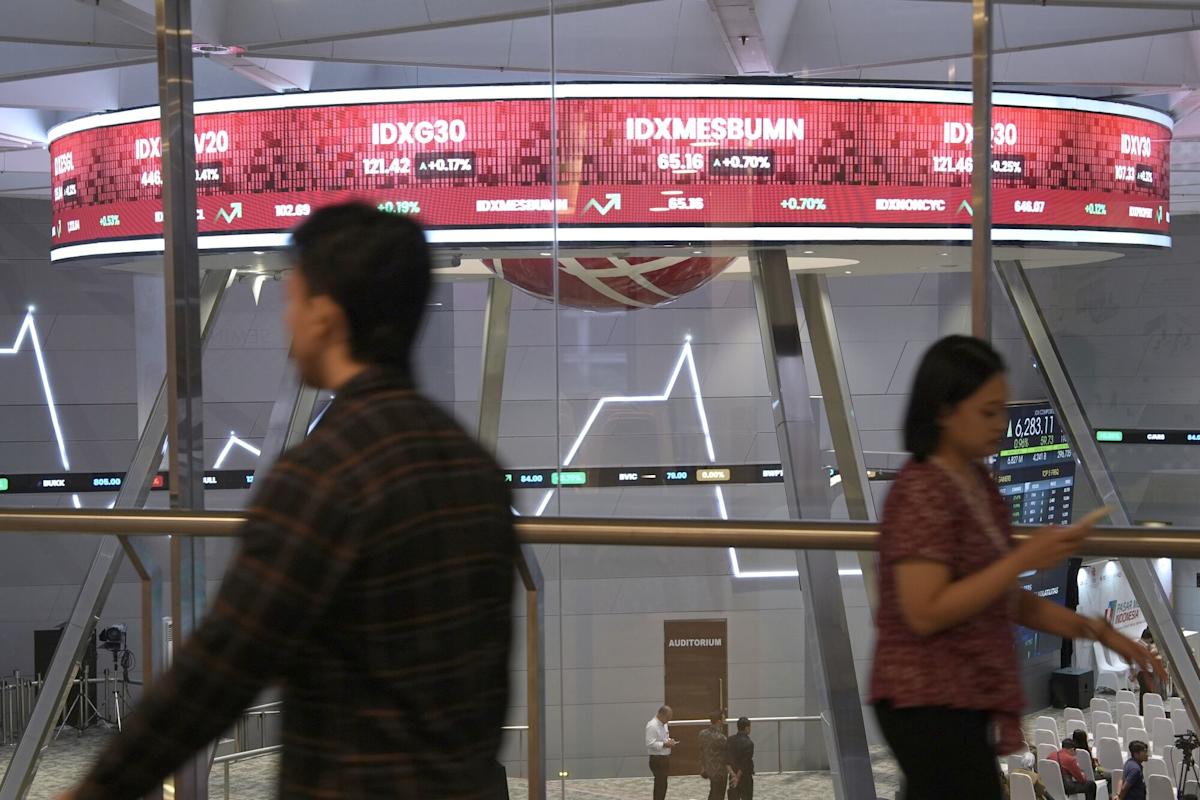
Indonesia’s benchmark stock index fell as much as 2.6% before paring its losses. Rising questions about the policies of President Prabowo Subianto have frayed nerves in the country, fueling a precipitous crash earlier this week.
Oil climbed after the US sanctioned a Chinese refinery, a marked step-up of measures to curb supply from Iran. Gold dropped after nearing a record high.
Some of the main moves in markets:
Stocks
-
S&P 500 futures were little changed as of 6:42 a.m. London time
-
Japan’s Topix rose 0.3%
-
Hong Kong’s Hang Seng fell 1.9%
-
The Shanghai Composite fell 1.2%
-
Euro Stoxx 50 futures fell 0.4%
-
Nasdaq 100 futures were little changed
-
Australia’s S&P/ASX 200 rose 0.2%
Currencies
-
The Bloomberg Dollar Spot Index rose 0.1%
-
The euro fell 0.1% to $1.0837
-
The Japanese yen fell 0.5% to 149.51 per dollar
-
The offshore yuan was little changed at 7.2534 per dollar
-
The Australian dollar fell 0.1% to $0.6296
-
The British pound fell 0.2% to $1.2935
Cryptocurrencies
-
Bitcoin fell 0.4% to $84,204.98
-
Ether fell 0.2% to $1,975.27
Bonds
-
The yield on 10-year Treasuries advanced one basis point to 4.25%
-
Japan’s 10-year yield was unchanged at 1.520%
-
Australia’s 10-year yield advanced two basis points to 4.39%
Commodities
This story was produced with the assistance of Bloomberg Automation.
–With assistance from Matthew Burgess and Winnie Hsu.
(Updates throughout. An earlier version corrected the volume of expiring options in paragraph 12)
Most Read from Bloomberg Businessweek
©2025 Bloomberg L.P.