


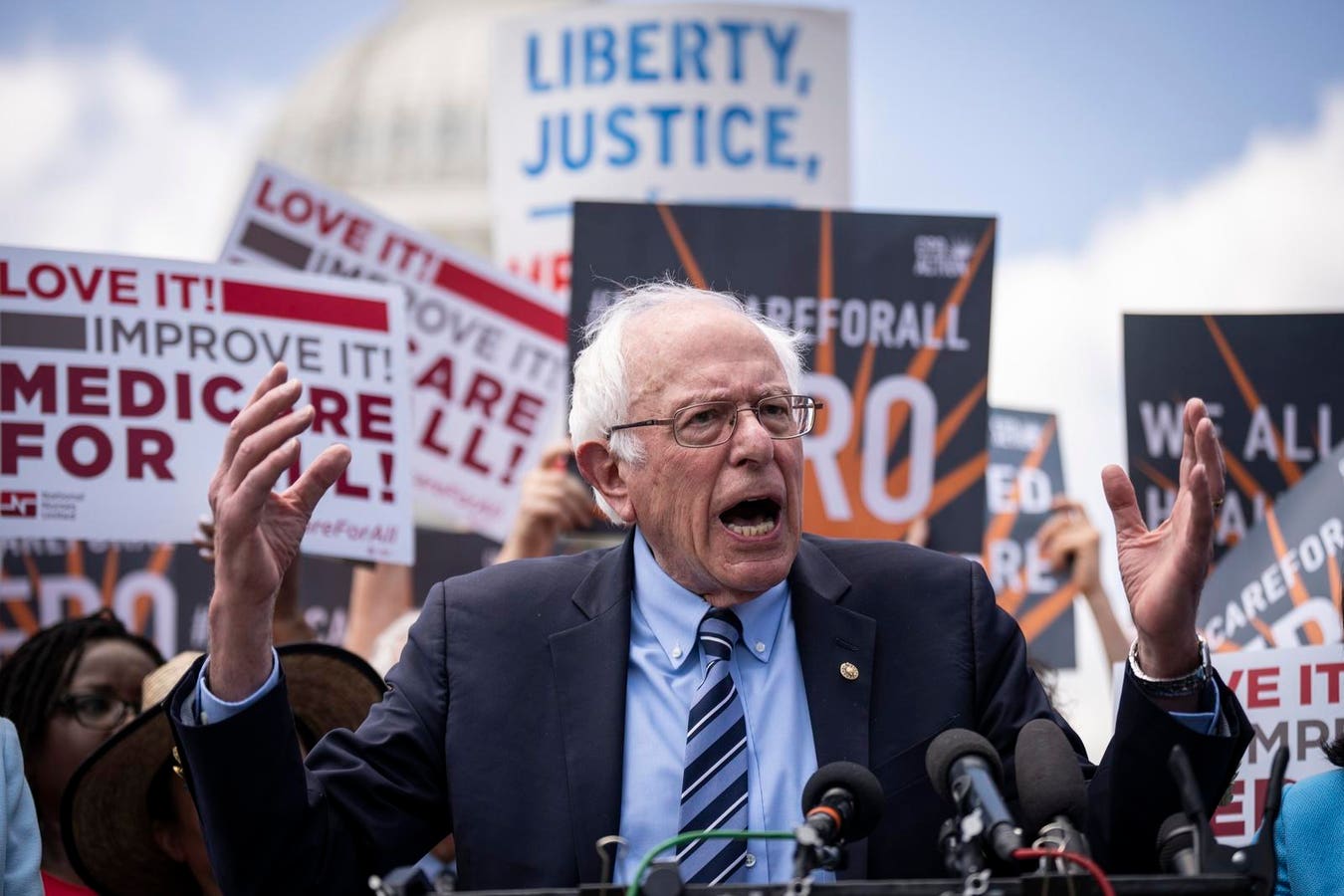
(Photo by Drew Angerer/Getty Images)
Is inequality back as a political issue? Senator Bernie Sanders seems to think so. He is leading a “Fighting Oligarchy” tour that has drawn thousands of people in several Midwestern cities. Railing against the influence of the wealthy is not new for Sanders, but he has found new targets in the coterie of wealthy individuals surrounding Donald Trump and especially Elon Musk.
Tracking public attitudes on the gap between rich and poor has interested pollsters since they began asking Americans about Senator Huey Long’s “Share the Wealth” campaign in 1934. Since 1966, the Harris Poll has asked people if they feel “the rich are getting richer and the poor poorer.” For decades, agreement has been in the 60% to 70% range. Around 60% in Gallup’s 40-year trend agree that money and wealth should be more evenly distributed, although in scattered Gallup polls, it has not been a high priority for Congress or administrations. On and off since 1973, the National Opinion Research Center’s General Social Survey has asked whether government should reduce income differences between the rich and the poor or whether government should not concern itself with this. A strong plurality has consistently planted themselves in the middle on NORC’s 7-point scale.
Several pollsters have recently added to our collection of polls on inequality. In a 2024 Pew Research Center poll, 51% said the gap between the rich and poor was a very big problem in the US and another 32% a moderately big one. When asked about what might lead to inequality, 89% said that rich people with too much influence contributed a great deal or fair amount, followed by 86% who said that about problems with our education system, and 74% because some people are born with more opportunity. Two-thirds (66%) said that some people working harder than others contributes a great deal or a fair amount and 62% said racial or ethnic discrimination did.
A 2025 Ipsos/Reuters poll release looked at the issue and suggested that inequality was a significant issue in the 2024 campaign. I’m skeptical. Six percent of registered voters in their October 2024 poll indicated that the gap between wealthy and average Americans was their most important issue, “the only issue I really care about” in the question’s wording, and another 43% said it was very important. In the poll, Kamala Harris led Donald Trump by 7 points among registered voters on having the best approach to the gap. More registered voters (70%) said the economy was their only issue (11%) or a very important one (59%), and Trump led her by 7 points on having the best approach to it. In almost all the polls I saw in 2024, inflation, the economy, or immigration were the public’s top concerns.
In a new 2025 Reuters/Ipsos question that did not include inflation or the economy as areas President Trump should focus on in his first 100 days, immigration ranked first at 27%. Half as many mentioned inequality (14%).
Inequality isn’t back as a political issue. It never left the stage. It’s not top of mind or a high priority for most Americans because it’s complicated. Americans don’t resent the rich, but most don’t admire them a lot either. They have long felt the wealthy have too much influence on government and the White House. Two-thirds in a recent Economist/YouGov survey believe Musk has a lot of influence on this administration. In another question, 44% wanted him to have no influence, 27% a little, and 17% a lot. In the new NBC News poll, 39% of registered voters had a positive feeling about him and 51% negative.
Americans don’t believe the rich pay their fair share of taxes, and they are content to tax them. While they agree the wealth gap is a problem, they are skeptical about government efforts to address it. In four Bloomberg questions from the past decade that asked if it was better for the government to implement policies to shrink the gap or better for government to stand aside and let the market operate freely even if the gap gets wider, people split evenly.
We’ll hear a lot more about inequality during Sanders’ tour and the debate to extend Trump’s tax cuts. Throughout the campaign, Trump led Harris as better able to handle taxes, and his sweeteners (such as no tax on tips or Social Security benefits) may dilute Democrats’ traditional lead on tax fairness. It is striking, however, how little our complicated views on inequality have changed over the last half century.
