


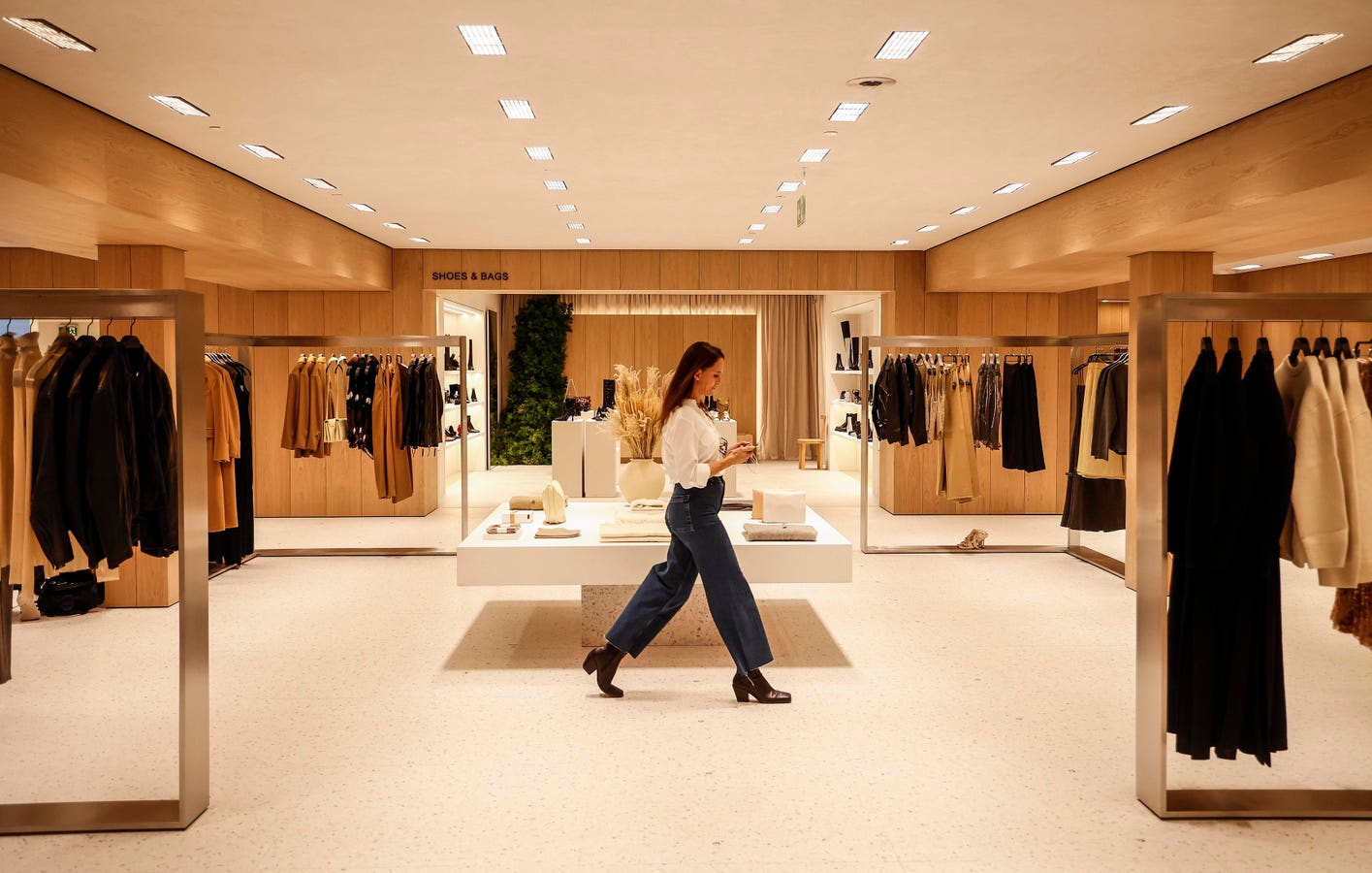
Fast fashion at Zara is moving towards mid-tier luxury — and the middle may disappear.
What’s Happening to High Street Fashion?
The high street as we know it is on shaky ground. Once defined by affordable, accessible fashion, the middle market in fashion retail is now squeezed between ultra-low-cost fast fashion juggernauts and mid-tier clothing brands with aspirational price points. In short, we may be witnessing the slow disappearance of fashion’s ‘middle market.’
In previous years, the appearance of eCommerce fast fashion players, like Boohoo, was often cited as a major factor in the decline of traditional brick-and-mortar fashion retailers. And now, with the explosive rise of ultra-fast fashion players like Shein and Temu, the race to the bottom only continues to get lower. With dresses starting at just £5 and lightning-fast turnaround times, these platforms cater to consumers who value speed and affordability over all else. According to The Business of Fashion, Shein’s valuation hit $66 billion in 2023, reflecting its unprecedented global reach.
The question is: what happens to the previously cheaper high street brands who are now priced out of the bottom and considered mid-level? Shein and Temu have forced traditional high-street retailers into uncomfortable territory and in the wake of Forever 21’s second bankruptcy, the lesson is clear: adapt or fold
New taking over old. E-commerce giant Shein hosts a pop up inside Forever 21 in Ontario last year. … [+]
Ultra-low cost clothing vs. Premium price repositioning
This split in fast fashion is accelerating — and for those clinging to the ‘affordable and cheerful’ bracket, survival is no longer about competing on price. Inditex (Zara’s parent company), for instance, has strategically raised prices to protect margins and chase more premium customers. At the same time, it’s also quietly hedging its bets with its budget-friendly sister brand, Lefties, where the prices are set low enough to compete Shein
Uniqlo has followed a similar route, with its parent company, Fast Retailing choosing to expand GU (Global Unique) — a sister brand targeting younger, trend-driven shoppers at lower price points. It’s a dual approach that lets Uniqlo compete across multiple tiers without diluting its core offering. But will the lower price brand ever be cheap enough to compete?
H&M has chosen to follow the more aspirational route, using designer collaborations — like its recent partnership with Magda Butrym — to shift consumer perception towards elevated fashion. Prices have crept upwards, a strategy also reflected in its sister brands COS and Arket who are edging towards what can only be described as ‘mid-tier luxury’ high street – no longer shy about four-figure price tags on coats. This repositioning is a bet: if they can’t win on price, they’ll win on perceived value, quality, and brand cachet, a strategy confirmed by H&M CEO who acknowledged that they can no longer compete on just price.
PLT have abandoned pink unicorns in favour of a more premium aesthetic.
What about the original fast fashion perpetrators? Now falling prey to the same competitive forces that it brought only a number of years earlier. The Boohoo Group, reported a 17% decline in revenue for 2023, but continues to highlight full-price sales as a key profitability driver. One of it’s brands Pretty Little Thing has recently rebranded, embracing a completely different ‘quiet luxury’ aesthetic (think muted tones and elevated font style) compared to it’s previous bubblegum pink branding.
Alongside the PLT premium rebrand are more premium price points too, despite maintaining the same fast-fashion business model and facing criticism over its ethical practices. It’s a move also reflected by the parent company, with the Boohoo Group deciding to change its name to the Debenhams Group – the name of the heritage high-street retailer it purchased a few years ago.
Founded in 1778, the Debenhams name brings premium heritage to the Boohoo Group (Photo by Mirrorpix … [+]
The future of fashion retail is increasingly divided
What we’re seeing isn’t just market evolution here — it’s market bifurcation. Consumers are either buying ultra-cheap, disposable fashion or trading up for quality and prestige (note, in the cases of many, higher quality is just the perception). Brands left in the middle are in danger of becoming obsolete.
Forever 21’s collapse is just the latest cautionary tale. And while players like Inditex, H&M, and Debenhams Group are innovating to stay afloat, the long-term future of high street fashion remains uncertain.
So what happens next? Will high street brands successfully rebrand as mid-tier luxury and pull consumers along with them? Or will the gravitational pull of ultra-cheap, trend-churning giants like Shein and Temu eventually swallow the market whole?
For now, the high street remains in flux. The middle ground is shrinking — and brands need to think about choose a side.
