


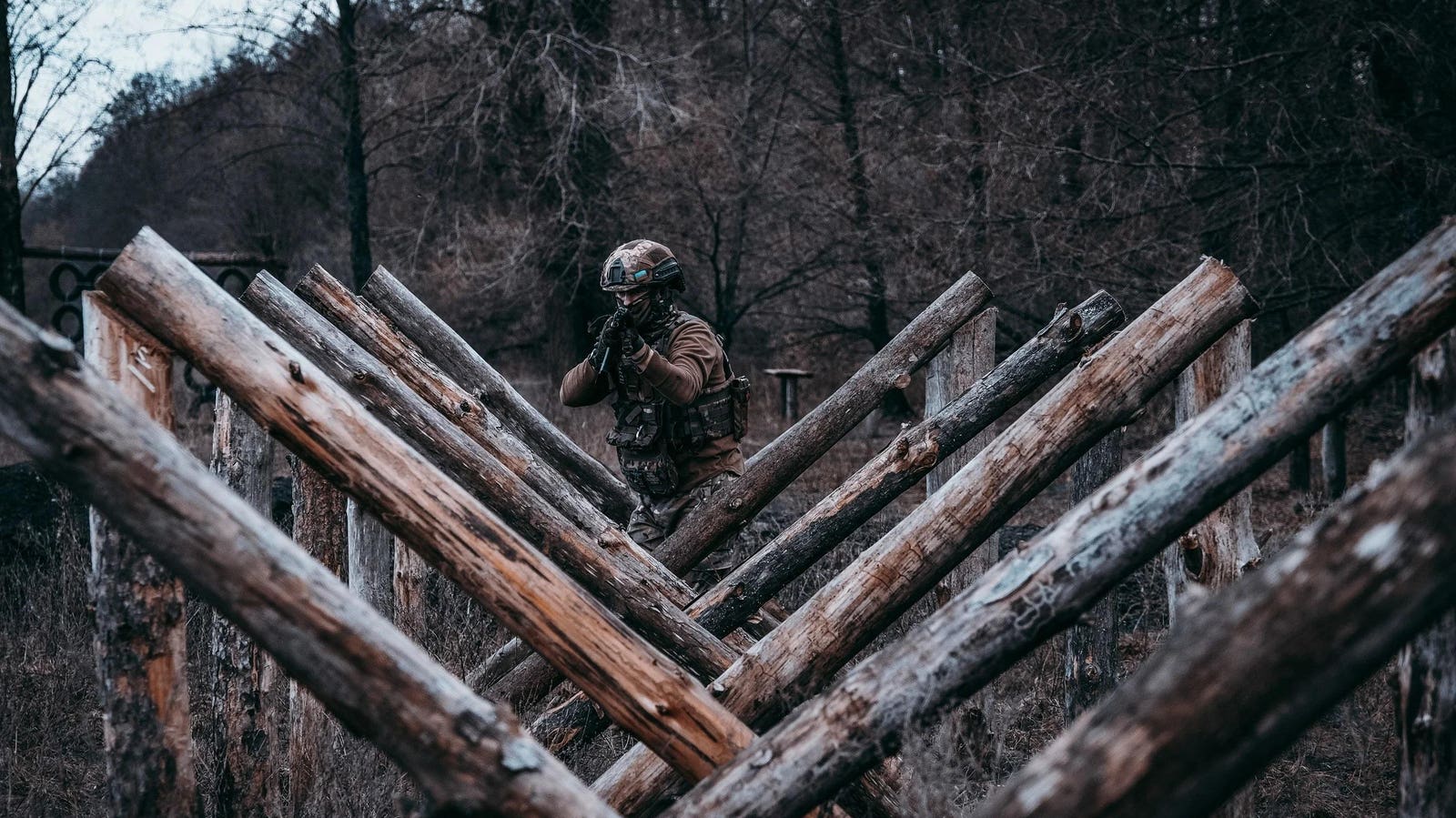
A Ukrainian soldier.
Ukrainian defense ministry photo
In December 2023, the Estonian defense ministry concluded Ukraine could turn the tide of the Russia-Ukraine war by killing or maiming 100,000 Russians in 2024.
In fact, Ukrainian troops killed or badly wounded closer to 200,000 Russian troops last year—double what Tallinn assumed was necessary.
And the casualty rate has actually increased in 2025. According to Gen. Oleksandr Syrskyi, commander-in-chief of Ukrainian forces, Russia lost another 100,000 troops killed or seriously hurt in just the first 10 weeks of this year.
But it’s still too soon to say whether the massive casualties Ukraine has inflicted on Russia have been massive enough to trigger the downward spiral in wartime readiness the Estonian ministry anticipated. Ukraine’s own heavy losses could alter the casualty math.
In the Estonian theory of victory, Ukraine could defeat Russia by eliminating more well-trained troops than Russia’s military training system can replace, thus initiating a gradual military-wide collapse.
“The Russian training system can be put under pressure and disrupted by inflicting sustained and increased attrition on Russian units in Ukraine, forcing the newly mobilized personnel to be deployed to the theatre prematurely,” the defense ministry explained.
Given that the Kremlin’s training bases can generate around 130,000 fresh—and reasonably well-trained—troops every six months, and 10,000 of those are support troops, Ukrainian commanders should aim to kill or badly wound 50,000 Russians in the same period, according to the Estonian analysis.
“This would constrain the Russian training system to deliver approximately 40,000 additional troops instead of 130,000 every six months,” the ministry asserted. Generating just 40,000 replacement troops twice a year would compel Russian commanders to bulk up their regiments with untrained troops—and that would “consistently degrade the quality of Russian force,” the Estonians claimed.
That should have the effect of “preventing Russia from regenerating offensive combat power.”
Good news for Ukraine: according to the best estimates, Ukrainian troops killed or wounded 315,000 Russian troops through 2022 and 2023. That’s 172,000 per year.
The loss rate accelerated last year, when as many as 210,000 Russians became permanent casualties—meaning they died or left military service for good after being severely wounded or deserting. Those figures come from a recent study by Frontelligence Insight, a Ukrainian analysis group.
Ukrainian artillery.
Ukrainian defense ministry photo
What collapse?
So why hasn’t the Russian army collapsed? The answer may be that it is collapsing—but very slowly. Consider that Russia’s yearlong offensive in eastern Ukraine ground to a halt last month. Maybe that’s because Russia deployed its best surviving troops to the successful effort to eject Ukrainian forces from the salient they held in western Russia’s Kursk Oblast.
Or maybe it’s because Russia is finally running out of well-trained troops and, as a consequence, losing its ability to conduct meaningful offensive action on a large scale. Just like the analysts in Tallinn anticipated.
But there’s another potential outcome—one that should worry friends of a free Ukraine.
If Ukraine’s own losses—100,000 dead and maimed troops a year for three years—are degrading its combat capabilities, the result could be a kind of battlefield impasse, where two exhausted combatants wearily exchange softer and softer blows—and neither can deliver a knockout punch. Yet.
That kind of impasse would ultimately favor Russia, Frontelligence Insight explained. That’s because there are 38 million people in Ukraine, and 144 million in Russia.
“There is a fundamental issue—Ukraine’s smaller mobilization base and poor mobilization campaign,” Frontelligence Insight warned.
Ukraine must degrade the Russian military faster than Russia degrades the Ukrainian military. At present, the casualty ratio favors Ukraine—but not nearly enough given Russia’s greater manpower reserves.
“Russia’s population is at least three times larger, and their recruitment system is better,” Frontelligence Insight explained. Thus, “Ukraine’s preferable loss ratio should be at least 1:3, rather than the 1:1.86 ratio reflected in current estimates.”
By killing, maiming or driving to desertion three Russians for every soldier they lose, the Ukrainians could deplete Russia’s most important resource—people—faster than Russia depletes Ukraine’s own most important resource, which is also people.
But it might take “game-changing external support” from allies for Ukraine to tilt the loss ratio more steeply against Russia, Frontelligence Insight explained.
That game-changing support almost certainly won’t come from the United States, which under President Donald Trump is rapidly aligning itself with Russia and other autocracies.
That leaves one realistic prospect: Europe. And while the leading European powers—the United Kingdom, Poland, Italy, Germany and France—have all talked about boosting aid to Ukraine, talk is cheap when it comes to killing Russians.
