


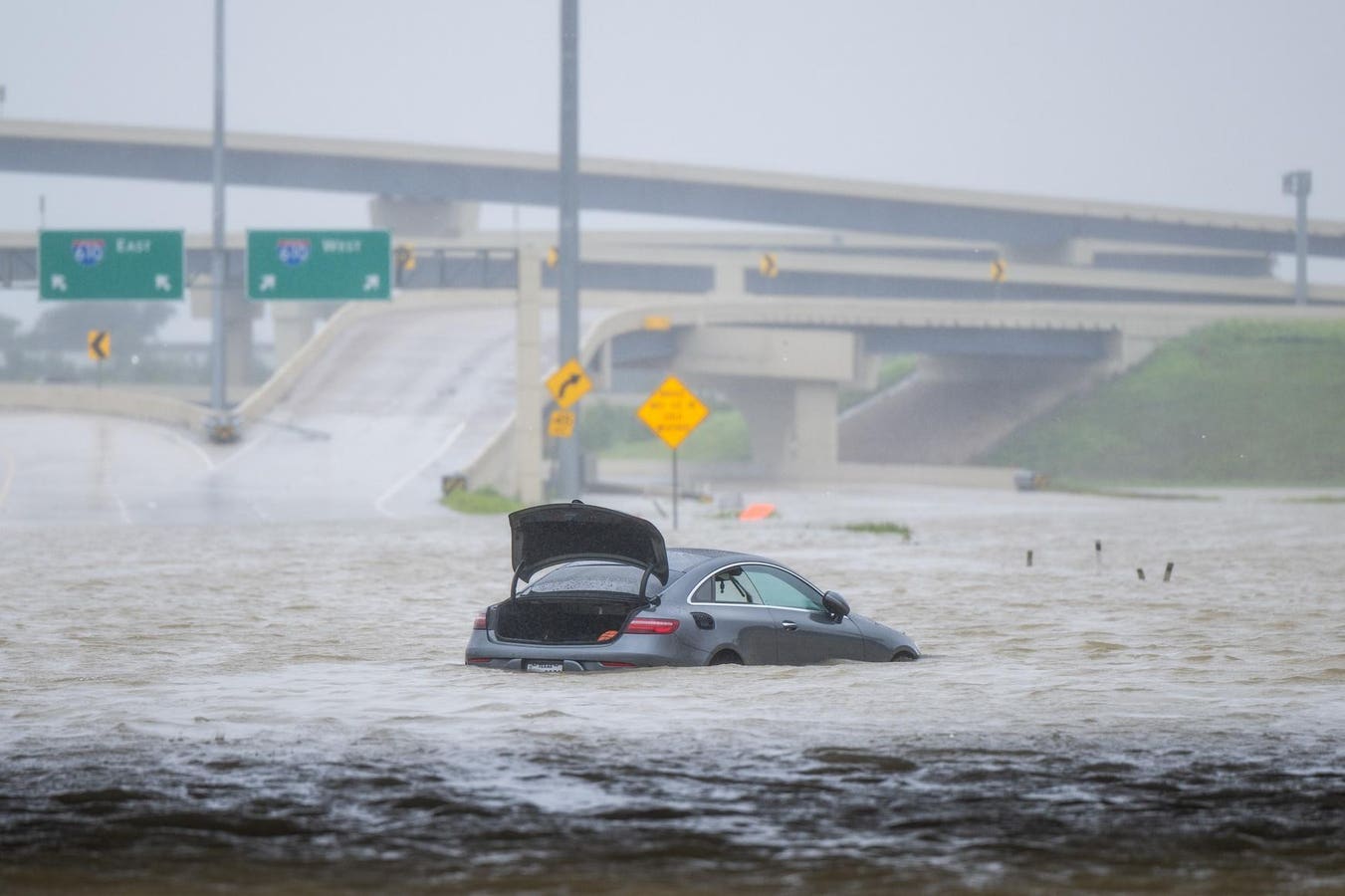
A vehicle abandoned in floodwaters on a highway after Hurricane Beryl swept through the area on July … [+]
Billions of people will lose their livelihoods and economic output reduced by up to 34% if the Earth is allowed to warm by 3 degrees Celsius this century, but investing less than 2% of GDP now could eliminate most of those losses, a groundbreaking new report from Boston Consulting Group (BCG) and the University of Cambridge has found.
Analyzing economic and climate science data, the report authors found that most economic climate damage this century will arise not from direct impacts like floods and fires, but from losses in productivity caused by reduced labor output, supply chain disruptions, and the collapse of crucial industries from fishing to tourism. From 2000-2023, direct U.S. losses from natural disasters attributed to climate change totaled $700 billion, but the harms to productivity were almost six times greater, amounting to $4 trillion in losses.
“What stands out is that productivity loss—not merely capital destruction—is the primary driver of economic damage,” said Kamiar Mohaddes, associate professor in economics and policy at Cambridge Judge Business School and a co-author of the report. “It is also clear that climate change will reduce income in all countries and across all sectors, affecting industries ranging from transport to manufacturing and retail, not only agriculture and other sectors commonly associated with nature.”
However, the report also shows that by investing 1% to 2% of GDP in efforts to both cut greenhouse gas emissions and to adapt to future impacts, warming could be limited to 2 degrees Celsius and economic harms reduced by up to 90%, with resultant damages amounting to only 2-4% of GDP. To achieve this return, the report calculates that investments in cutting emissions (mitigation) would need to rise nine-fold, while investments in strengthening systems against damage (adaptation) would need to rise 13-fold. But, as the report authors state, the return on investment is compelling.
“The economic case for climate action is clear, yet not broadly known and understood,” said Annika Zawadzki, BCG managing director and partner, and a co-author of the report. “Investment in both mitigation and adaptation could bring a return of around tenfold by 2100.”
The authors conclude that such returns represent a “massive opportunity for humanity.” Looking at the average of the 11% to 27% cumulative economic output secured by climate investments, they found that:
- Just one-eightieth of the resulting savings, or $324 billion, could eradicate global extreme poverty.
- One-seventh of the savings could cover all global infrastructure investment needs this century, across sectors including energy, telecommunications, transport and water.
- Spending on health care could be tripled, globally.
- An eighth of the savings could cover all global military expenditures until 2100.
The report outlines five steps to help educate the public and political leaders about the risks and opportunities of climate inaction and investment:
- Reframe the debate on the costs of climate change, such as putting the economic cost for climate action on the agenda of United Nations and other multilateral meetings.
- Create transparency on the net cost of inaction, including robust climate risk reports by companies and routine macroeconomic assessments by central banks.
- Strengthen national climate policies to accelerate mitigation and adaptation, such as prioritizing funding and policies to help communities cope with climate risks.
- Reinvigorate international co-operation on climate change, including the submission of ambitious national climate plans ahead of the COP30 climate summit in Belém, Brazil in November 2025.
- Advance understanding of the net cost of inaction, including an understanding of the compounding impacts of climate change on the global economy this century.
The BCG-Cambridge report comes hot on the heels of a recent report by financial analysts indicating that countries’ current climate targets are risking “catastrophic societal and economic impacts” by overlooking significant risks to both nature and society. In January, the Institute and Faculty of Actuaries (IFoA), who are finance professionals that calculate risk and uncertainty, warned that “unmitigated climate change and nature-driven risks have been hugely underestimated,” and could lead to a 50% loss in global GDP between 2070 and 2090.
Speaking on the release of that report, Sandy Trust, lead author and IFoA Council Member, told media: “You can’t have an economy without a society, and a society needs somewhere to live. Nature is our foundation, providing food, water and air, as well as the raw materials and energy that power our economy. Threats to the stability of this foundation are risks to future human prosperity which we must take action to avoid.”
