


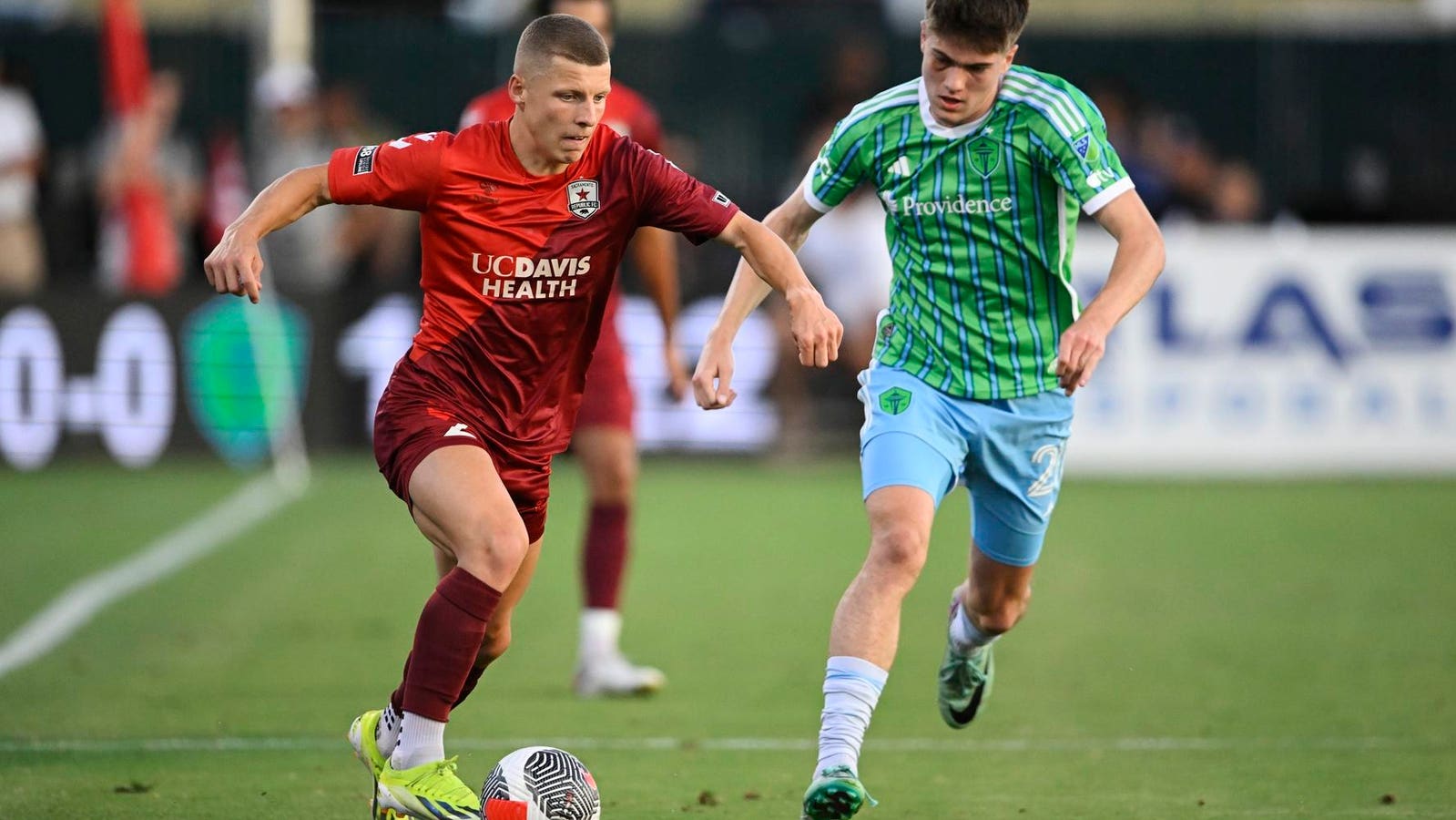
Jack Gurr, left, of the USL Championship’s Sacramento Republic FC dribbles against Reed … [+]
Last week, United Soccer Leagues revealed plans to launch a men’s professional soccer league that would rival Major League Soccer as a top-tier domestic competition in the United States by 2027 or 2028.
While rivaling top-flight leagues would be unusual in global soccer terms, it’s nothing new in North American professional sports. In pro baseball, football, basketball and hockey, rival league launches have eventually led to mergers.
But the last of those occurred in the late 70s, and quite a lot has changed in pro sports since then. Most notably, the startup costs required to launch a modern major pro franchise have increased exponnentially. And the prospect of footing those contests when the chances of survival seem uncertain could be a major deterrent for potential USL Division One ownership groups.
If MLS ownership wants to quash competition from USL before it is born into existence, it could aim to make those costs even higher by investing far more into its own clubs in terms of player wages. At least that should be how the MLSPA frames the situation heading into the process of reaching a new collective bargaining agreement after the current one expires at the end of the 2027 season.
Much like with the founding of the American Football League – which was comprised of teams owned by folks who bid for NFL expansion rights and lost – USL Division One could court cities that fell short in their flirtations with MLS as it expanded from 14 teams in 2007 to its size of 30 today.
The USL already has franchises in many of those cities in the USL Championship, the USL’s top level of competition currently, a league sanctioned as a division 2 competition by the U.S. Soccer Federation.
And it could counter concerns over the uncertainty of launching a new league with a far less expensive entry fee than the $500 million that MLS reportedly charged its most recent expansion franchise, San Diego FC. That would allow potential new USL Division One owners to field a caliber of roster similar to MLS with much less initial financial risk, given how relatively slender MLS payrolls still are.
The highest last season was Inter Miami’s at $42 million, according to Spotrac, and the median payroll was Minnesota United’s at $17.4 million. And set against the MLB, NBA, NFL and NHL, those salary costs are disporportionately low relative to revenue.
The latter three employ salary caps that all aim to bring sports-related revenue sharing into a roughly 50-50 proportion between ownership and players. In MLS, Forbes’ 2024 franchise valuations found teams earning an average revenue north of $60 million, but only three teams with wage bills at even 40% of that figure.
In several rounds of protracted negotiations with the MLSPA in recent seasons, ownership has argued those lower costs were a requirement to keep the league functioning responsibly. But now they make the prospect of launching a new product of similar quality more attainable.
If MLS ownership really wants to quash the USL’s efforts, the MLSPA has to make it see that one of the easiest ways to do so is to bring player wages more in line with the rest of North American major sports in terms of revenue sharing. U.S. Soccer may have a rubrick of standards it uses to sanction a league as Division 1 status. But in a closed system – i.e. one without promotion and relegation in either USL or MLS – that matters less than the court of public opinion, where the league with the higher quality of play will ultimately retain that unofficial first division ranking.
That said, it’s unclear whether MLS owners will believe the USL truly offers a credible threat, or if a rival league would even be so bad for MLS.
After all, it’s not the first time a rival league tried to challenge the MLS’s sole ownership of first division status status in the United States. And MLS owners might also feel it’s better for their bottom line to continue to increase roster investment more gradually, in the belief that the best way to solve a challenge from a successful USL Division One is to negotiate a merger when the time comes.
