


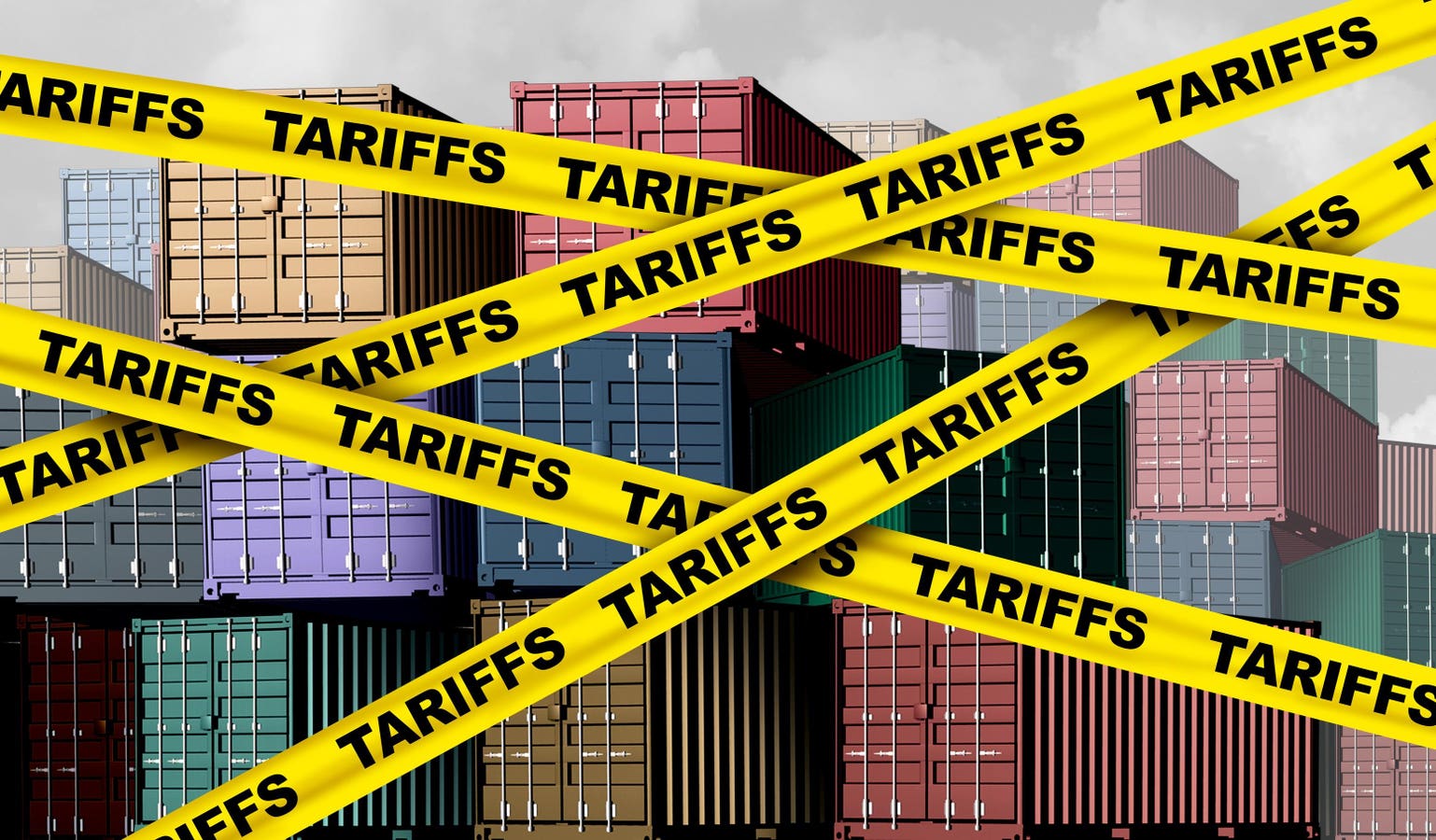
Without a long-term plan, tariffs will accomplish little other than raising prices for everyone in … [+]
There has been extensive discussion about the tariffs the Trump administration wants to impose on U.S. trading partners. Much of this discussion remains inconclusive regarding the specific amounts, timing, affected countries, and the particular goods that would be subject to these tariffs. However, one proposal that appears certain is a 25% tariff on steel scheduled to take effect on March 12.
For the most part, tariffs function as taxes paid by U.S. importers rather than by exporters in foreign countries. This means that a tariff is a tax, transferring wealth from local consumers (essentially everyone, since steel is widely used) to the U.S. government. Whether and how that revenue is redistributed is a separate issue.
Tariffs are not the only taxes imposed on imports. Duties and local taxes also play a role. Duties are generally applied to specific imported goods from any country and are usually determined through international trade negotiations. They are intended to encourage domestic production of those items. Tariffs, by contrast, are imposed unilaterally on imports from specific countries and are designed to discourage consumption of goods from those nations. Additionally, local taxes such as value-added tax (VAT) serve to generate revenue for the local government. The U.S. does not have a VAT, but many other countries do.
Some of the tariffs currently being proposed by the U.S. appear to retaliatory rather than strategic, instead of serving the broader purpose of incentivizing domestic production. President Trump has made this clear, accusing longtime trading partners of being “unfair” and recently including foreign VAT in his list of grievances against trade counterparts.
The case of steel
The proposed 25% tariff on all steel products is an interesting example. The U.S. produced 86 million tons of steel in 2024 at a 76% capacity utilization rate. This suggests that, in theory, domestic producers could increase production by another 27 million tons before reaching full capacity. However, the U.S. still imported approximately 29 million tons. Expecting domestic producers to meet this demand with existing infrastructure is unrealistic, because capacity utilization rarely exceeds 80% – a number that happens to be the goal of the White House new policy. To close the import gap, new steel plants would need to be built.
Constructing a new steel mill with an annual output of 1 million tons typically takes between two and four years and costs between $1 billion and $4 billion. Therefore, achieving steel self-sufficiency at current consumption levels would require meeting three critical conditions:
- Competitive Pricing – The additional steel produced domestically must be competitively priced against imported steel. Tariffs are the easiest and most expedient way to achieve this by making imports 25% more expensive through taxation.
- Comprehensive Industrial Policy – A well-designed policy, similar to the CHIPS Act of 2022, which allocated public funds to increase domestic semiconductor production, would be needed to support steel manufacturing. Expanding capacity by 29 million tons could require investments of up to $100 billion in the coming years, in reality much more if the goal is long-term self-sufficiency, and would likely involve government support.
- Policy Stability – Tariffs and industrial policies must remain in place for an extended period to justify costly investments in steel production. Companies need long-term assurances before committing to large-scale infrastructure projects, even with the help of government subsidies.
Tariffs represent only the first step in this three-pronged approach, as they can be implemented with the stroke of a pen. However, a long-term industrial policy, akin to China’s five-year plans, would require deliberation, consensus, and a level of commitment that has been largely absent in U.S. policy making of the last few decades, and virtually unthinkable today.
The need for a long-term strategy
Notably, despite being in office for less than a month, the Trump administration is already revising the CHIPS Act, casting doubt on its long-term viability. Given this precedent, it is difficult to expect the private sector to invest in long-term projects when policy stability can hardly be expected from one administration to the next.
If the uncertain future of the CHIPS Act highlights the challenges of long-term planning, the unpredictable shifts in tariff policy underscore the difficulties in even understanding short-term trade strategy. Initial declaration of tariffs have been followed by postponements, while the threat of reciprocal tariffs has morphed into ordering a study to analyze its effects. While Presidential Proclamations make clear that the new steel tariffs will be applied regardless of county of origin, the administration is reportedly considering carve-outs for certain countries. Even defining what the U.S. government now considers a tariff is unclear—is a foreign VAT a tariff equivalent?
Moreover, the ultimate objective of these tariffs remains ambiguous. Are they designed to stimulate domestic production, as the Proclamations assert, or are they leverage in unrelated demands, such as pressuring Mexico and Canada to curb immigration or fentanyl trafficking?
Without a clear purpose, tariffs—if implemented—will primarily serve as a new tax that raises the cost of imports. They may also facilitate a wealth transfer from consumers to domestic producers by artificially increasing the cost of imported steel by 25%. This would allow domestic producers to raise prices by slightly less than that margin while still remaining cheaper than their foreign competitors. Preventing such price hikes through price controls is highly unlikely. Unsurprisingly, the U.S. steel industry has cheered the prospect of tariffs, while the National Utilities Contractors Association (NUCA) warned that they will increase costs and delay critical infrastructure projects.
Impact on investments
Ultimately, the most likely outcome of these tariffs, as proposed, is an increase in consumer prices, with little or no impact on enhancing U.S. competitiveness. Investors may want to consider the risks this brings to their portfolios.
Higher inflation will keep the Fed on hold and raise the possibility of higher rates, which is likely to impact their portfolios by worsening sentiment and negatively impacting earnings. The best result would be that the proposed tariffs may never see the light of day—not an unreasonable assumption given the fast-changing nature of current policy-making.
