


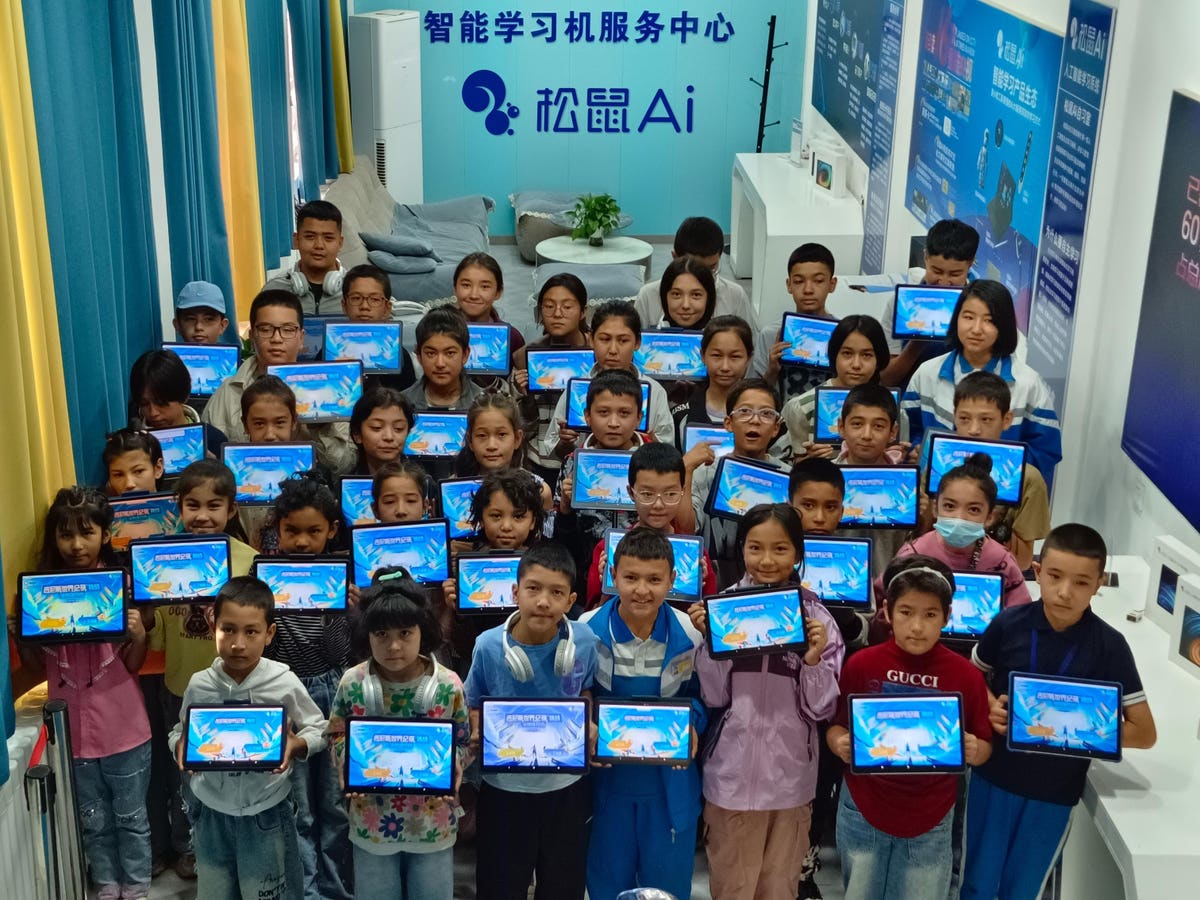
Some 112,000 students using Squirrel Ai equipment broke a Guinness World Record for the world’s … [+]
(Note: This post is a translated version of Forbes China’s cover story in a special AI issue published in December.)
In the spring of 2018, Derek Li stood on stage in front of a packed auditorium of educators, technologists, and investors at an innovation forum. His slight frame was dwarfed by the towering screens behind him. “Our dream,” he told the audience, “is to provide a virtual tutor that is Socrates, da Vinci and Einstein rolled into one, for every student.” A few chuckles rippled through the crowd as Li’s vision seemed too audacious to be real. By the time he left the stage, the room was filled with applause.
In an interview with Forbes China, Li recalled the moment as more than a presentation; it was a declaration of deep-rooted purpose. A former Math Olympiad champion turned serial entrepreneur, Li had spent years frustrated by the inefficiencies of traditional education systems. He imagined a world where all students, regardless of their background, could receive a customized education that addresses their unique strengths and weaknesses through new technology. “Every child deserves access to an education as unique as they are,” Li said.
By 2014, Li had taken the first step toward making his dream a reality, launching what would become an edtech company recognized for a groundbreaking approach to personalized learning—Squirrel Ai. The startup’s proprietary software brought an adaptive learning ecosystem to laptops and tablet computers to students gathered at dedicated physical learning centers. Squirrel Ai has in the past decade gone one to build a network of more than 24 million students through 3,000 learning centers. Its success has led to international recognition, such as Time Magazine’s 2024 Top EdTech Companies list; the company last year set a Guinness World Record for hosting the largest online math class, with over 112,000 students participating simultaneously.
Success has led Li and his cofounder, Dr. Joleen Liang, to begin laying the groundwork to bring his vision to the United States. By establishing Squirrel Ai North America last year with Li as chairman and Liang as president, the company now aims to reshape education on a global scale.
Li’s rise to one of the most influential global figures in edtech began in the bustling central China city of Zhengzhou, where he spent his childhood immersed in books and numbers. His natural aptitude for mathematics was evident as he skipped multiple grades and earned top honors in the China Mathematical Olympiad. Beyond academics, Li’s curiosity drove him to also explore business opportunities. By middle school, he was trading cassette tapes and computers and even experimenting with the stock market. For him, solving problems wasn’t just an academic exercise but a way of life, he recalled.
This mindset carried into his teenage years as he focused on improving his emotional intelligence, a soft skill he believed was critical for success but didn’t come naturally to him. Rather than accept this limitation, Li approached emotional intelligence as a puzzle to be solved. He broke it into 27 distinct components and trained himself in areas such as becoming a more engaging conversationalist and maintaining composure under criticism. “I realized anything could be learned if you approach it systematically,” he said. This belief in methodical problem-solving became a cornerstone of his thinking and would later form the foundation for how Squirrel Ai’s underlying technology works.
Squirrel Ai co-founder and chairman Derek Li.
By high school, Li earned a spot in Shanghai Jiao Tong University’s prestigious Computer Science Experimental Program, a rare achievement for someone of his age. While there, he lived among graduate students, worked closely with professors, and pursued advanced studies in mathematics and computer science. Many of his peers followed traditional career paths, but Li’s entrepreneurial mindset had pushed him to consider how technology could address complex, real-world problems.
After earning a degree in international economic law in China, Li co-founded two companies, including Shanghai-listed Only Education, whose market capitalization once topped $22 billion. Yet he was drawn to deeper challenges — the foremost being how to fix the inefficiencies he had experienced firsthand in traditional education. Growing up, he saw how rigid structures and rote memorization left little room for personalized learning. “The current one-size-fits-all method just wasn’t working,” he explained. “No two students are alike, and thus no two learning paths should be alike.” This conviction led Li to launch Squirrel Ai.
Li’s goal, he said, was not to create just another tutoring company but to completely reimagine the way the world learned. Combining his entrepreneurial experience, a systematic approach to problem-solving, and a passion for education, Li set out to build an adaptive learning system powered by artificial intelligence (known as LAM – a Large Adaptive Model engine) that could achieve what traditional education systems could not: personalized, data-driven learning experiences that could adapt to each student’s needs.
The cornerstone of Li’s approach has been Squirrel Ai’s use of “nanoscale knowledge points,” a concept he pioneered to break down subjects into their smallest components. This reflected the same methodical, problem-solving mindset that shaped Li’s thinking as a teenager when he deconstructed emotional intelligence into manageable steps to master it. Building on that principle, Squirrel Ai employed AI-driven algorithms to assess a student’s mastery of carefully defined micro-concepts and pinpoint gaps in understanding. For example, middle school math was divided into over 10,000 nanoscale knowledge points, compared to the 2,000–3,000 typically found in textbooks.
This granularity enables Squirrel Ai to create learning paths adapted to each student’s specific needs. In 2017, Squirrel Ai launched its Intelligent Adaptive Learning System (IALS), a platform designed to deliver dynamic lessons, practice assignments and real-time feedback; the system was upgraded to a LAM in 2022, boosting its capabilities for personalized and effective human-machine interactive learning experiences, Li said. Students begin with a diagnostic test that evaluates their knowledge of key skills. Based on the results, the AI crafts an individualized curriculum that evolves as the student progresses. The system analyzes millions of data points, continuously refines its recommendations and aims to uncover previously unseen connections between concepts to enhance learning outcomes.
In 2019, Li along with collaborators John Couch, Apple’s first vice president of education, and Jason Towne, a Harvard-affiliated research fellow and author who is now Squirrel Ai’s director of corporate strategy, co-authored the Chinese-language edition of the critically acclaimed book Rewiring Education: How Technology Can Unlock Every Student’s Potential. “I’m proud to support Squirrel Ai as it continues to drive a global effort in AI-empowered education that will benefit millions of additional students worldwide,” Couch said in a statement to Forbes China. “Artificial intelligence offers a unique opportunity to rewire education, ensuring the success of every student,” he said.
Derek Li, right, and John Couch, left, were among the co-authors of the Chinese-language edition of … [+]
The trio’s book, which quickly became the bestselling education text in China that year, predicted the transformative impact of artificial intelligence on mainstream society. This proved prescient with the rise of ChatGPT and other large language models just three years later.
What Li didn’t foresee was the level of pushback AI would face in the United States, where fears of automation replacing human jobs, including those of teachers, have become a national concern. These anxieties only intensified as AI’s performance in fields as far-flung as healthcare and education have grown. To help address those concerns, Li and Towne this year co-authored an article for the World Economic Forum titled: “How AI and Human Teachers Can Collaborate to Transform Education.” The article emphasizes that no matter how advanced AI becomes, it cannot replicate human qualities like emotional intelligence, which are essential in education. However, they argue, the role of teachers must evolve in the age of AI. “I have always envisioned teachers moving away from lectures and one-size-fits-all lessons as they become what I call ’learning architects,’” Li said.
Li likens the future role of teachers to that of an airline pilot, monitoring and guiding the process while AI handles the mechanics of lesson pacing and assessment. Teachers, he explained, will transition from being mere providers of information to facilitators of learning, behavior analysts, and mentors, focused on emotional communication and building connections with students. “AI should relieve educators of routine tasks like grading and knowledge delivery and empower them to focus on the most important aspects of teaching: building relationships, fostering creativity, and guiding students toward their goals. The role of teachers, the methods of learning, and the definition of education itself must evolve if we want to unlock the full potential of human intelligence,” Li said.
Despite early challenges, including the 2021 ban on after-school tutoring in China, Squirrel Ai not only survived but thrived. Shifting to self-study learning centers and smart learning tablets, the company reaffirmed its commitment to accessibility and resilience; it built up revenue of $324 million by 2024 helped by strong demand for its AI-driven products and a scalable business model, Li noted. The company’s success has established Li as a thought leader in AI education. He has been invited to speak and be interviewed at the Summer/Winter Davos Forum, Web Summit, Stanford University and Singularity University Global Summit; a TED Talk and media coverage have also followed. This increased visibility helped secure partnerships with renowned institutions such as SRI International, Carnegie Mellon University, and affiliates of MIT and Harvard, further solidifying Squirrel Ai’s place as a significant player in the global edtech movement, Li said with pride.
By mid-2024, Li had begun executing his long-term ambition to bring Squirrel Ai to the global stage, starting with the United States. Under the local leadership co-founder Liang, the initial phase will launch in California, where Squirrel Ai plans to introduce its intelligent learning tablets along with a network of franchised learning centers. Ultimately, the company aims to open more than 3,000 locations nationwide. The timing aligns with favorable market conditions, Li believes, including a U.S. edtech market projected to reach $348 billion by 2031. He particularly cited growing interest from American parents in Asian communities already familiar with Squirrel Ai.
This expansion represents not just a geographic shift but a cultural one for Squirrel Ai. To meet the needs and expectations of American students and parents, Li identified fundamental differences in educational priorities. While parents in China often focus on standardized test performance, American parents tend to place greater value on executive function skills, such as critical thinking and creativity, he said. In response, Squirrel Ai developed a new framework. “Our MCM System integrates Model Thinking, Capacity Building, and Methodology to equip students with both academic knowledge and the essential skills needed for real-world success,” Li explained.
Li has made other changes to better align with the U.S. market. In China, Squirrel Ai partnered with Master Teachers, an official designation for the most effective educators. For Squirrel Ai North America, the company sought out national and state “Teachers of the Year” to design and develop English-language content in math, science and other fields. These educators create two-to-three minute video lessons which align with Li’s long-term vision of successful human-AI collaboration.
To help with global expansion, Squirrel Ai has also assembled an even more diverse international team. In 2023, for instance, it hired Qingsong Wen, a Ph.D. from the Georgia Institute of Technology and former AI researcher at Alibaba Damo Academy as its Chief Scientist and head of AI Research.
Li also addressed head-on potential worries among U.S. parents about their children’s data. As Squirrel Ai collects vast amounts of data to personalize learning, questions about data privacy and security are inevitable. Li emphasized the company’s commitment to ethical AI practices, ensuring that all data collected is used exclusively to enhance educational outcomes while safeguarding student privacy.
“Squirrel Ai North America is fully independent of Squirrel Ai China,” Li explained. “The U.S.-based entity operates as a completely separate company under a licensing arrangement, rather than as a division of the main corporation. This approach directly addresses issues of foreign influence and helps avoid the fate of other Chinese-born companies, such as ByteDance’s forced divestiture of TikTok.”
“No personal data collected by Squirrel Ai North America will go to China,” Li said. “Any data we collect is strictly related to learning analytics so that we can continue improving our adaptive learning system.” He added, “If there’s one thing Americans won’t have to worry about, it’s what will happen to their data.” The fact that the U.S.-based learning centers will be operated by American franchisees rather than the company itself provides an additional layer of reassurance, Li said. Whether these measures will be enough to fully dispel skepticism is yet unknown, Li continued. Ultimately, the company’s success in the U.S. may come down to the effectiveness of Squirrel Ai itself.
As Squirrel Ai embarks on its U.S. expansion and strives to further establish itself as a global leader in edtech, Li is staying focused on what he sees as the bigger picture: a future where personalized learning becomes the norm, empowering students to pursue their passions, overcome their challenges, and reach their full potential. Despite his professional achievements, Li noted that he is deeply grounded as a dad of two young sons. He regularly tests Squirrel Ai’s system with his children, who are already mastering subjects far beyond their grade level. “I’m building the tools I wish I had as a student,” he said.
Whether he can succeed and build more success globally remains to be seen. But one thing is certain—we’re about to find out.
