


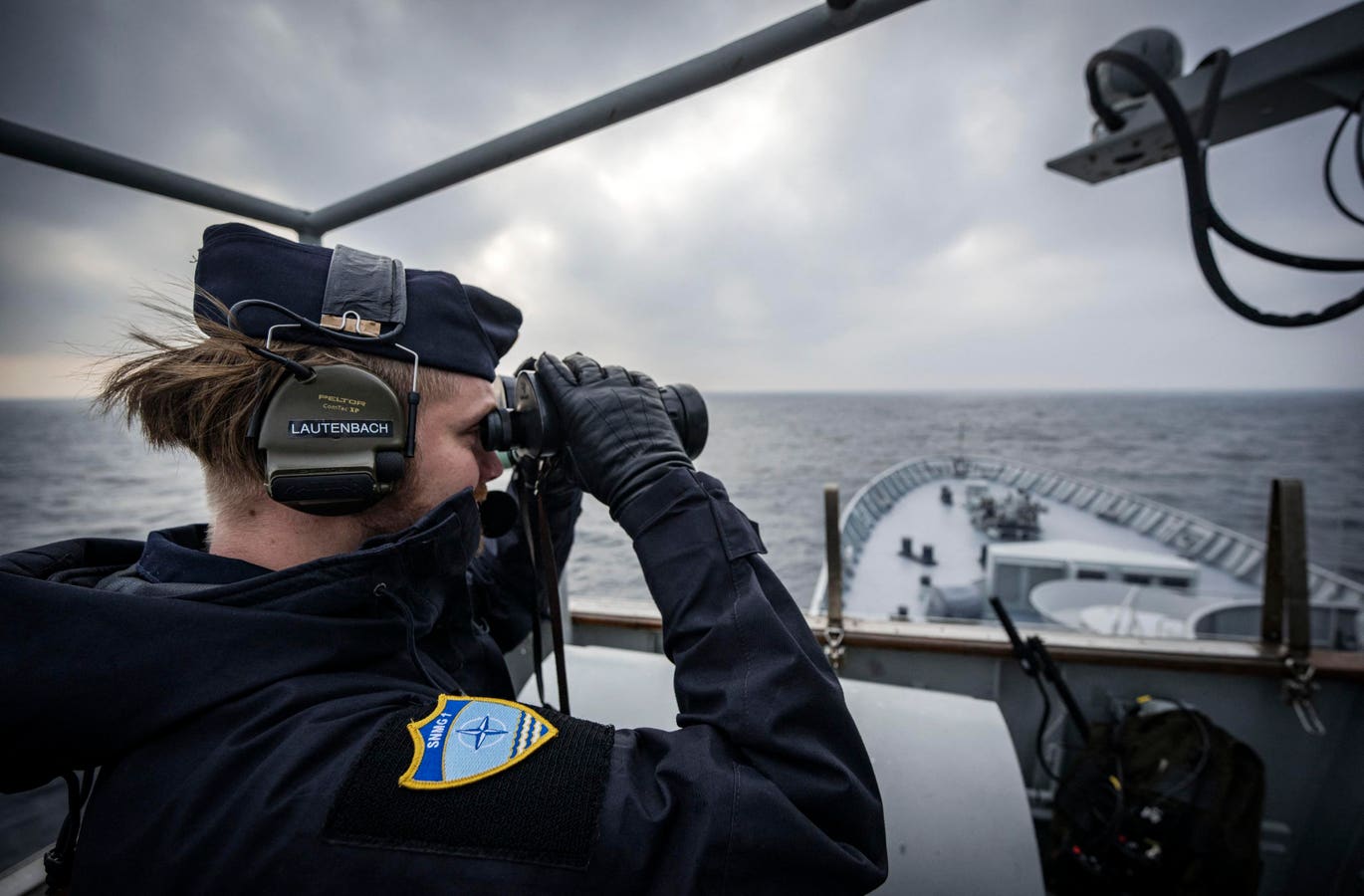
A picture taken on February 4, 2025 shows optical reconnaissance with binoculars and documentation … [+]
Forget mind games by corporate moguls—Russia and China are taking severance to a new level. Six submarine cables in the Baltic Sea and Taiwan Strait have been severed since November—the latest reported this week by Russian state news. Ships affiliated with Russia and the People’s Republic of China are suspected in all of them. After three undersea cable cuttings involving NATO members, NATO finally responded in January with a maritime patrol operation. But it should not have taken three cuts for NATO to be ready. Cable cutting is a tactic right out of the PRC and Russia’s lawfare playbooks—one Russia used in its invasion of Ukraine. NATO allies and Taiwan must prepare the legal groundwork to respond faster—and prevent dire geopolitical and economic consequences.
A submarine cable is a cable laid on the seabed between land-based stations, usually to carry telecommunication signals or power. Hundreds of cables crisscross the globe carrying 98% of internet traffic, making them essential to the global economy. Ninety-nine percent of undersea cables are owned and maintained by private companies. Underwater cables are unintentionally injured 150-200 times annually, usually by fishing vessels or ship dredging.
Incidents or Accidents in the Baltic Sea and Taiwan Strait
The captains of ships suspected in the recent cable cuttings in the Baltic Sea and Taiwan Strait likewise claim the incidents were accidents. Some U.S. and European officials agree. However, the temporal and geographic proximity of the six incidents, and the ships’ relationships to Russia and the PRC, make them suspicious. So do reports that Chinese engineers have applied for patents to develop cable-cutting devices. On 17-18 November, a PRC-flagged vessel carrying Russian fertilizer is suspected of damaging two cables linking Sweden to Lithuania and Finland to Germany. On December 26, Finland detained a Russian tanker flagged in the Cook Islands on suspicion of cutting a power cable between Finland and Estonia on Christmas. In late January, Norway briefly detained a Norwegian-owned, Russian-crewed cargo ship en route to Russia on suspicion of severing a cable between Sweden and Latvia. In the latest incident, Russian state media reported that a Baltic Sea cable owned by Rostelecom was damaged on February 8. Finland is closely monitoring the repair effort.
Meanwhile, similar incidents have been occurring near Taiwan. On January 6, Taiwan intercepted a Hong Kong-owned freighter after an undersea cable near Northern Taiwan was damaged. And on January 22, Taiwan reported that two cables linking its Matsu Islands—on the front lines in any potential PRC invasion of Taiwan–to the rest of Taiwan were cut by “natural degradation.” Two undersea cables are unlikely to degrade naturally at exactly the same time.
Why International Law Is Insufficient To Protect Undersea Cables
Russia and the PRC are exploiting gaps in international law to achieve geopolitical aims, a strategy known as lawfare. Russia and the PRC know that gaps in international law make undersea cables vulnerable to damage or exploitation with little accountability—and make it difficult for law-abiding states to respond. Only 36 states signed the 1884 Convention for the Protection of Submarine Telegraph Cables, including the US and Russia, but not the PRC. The treaty makes it illegal to injure a submarine cable in peacetime. However, only the flag state of the alleged perpetrator vessel or the state of nationality of an alleged perpetrator has jurisdiction to investigate and prosecute cable incidents. Warship captains may demand documents proving the nationality of a vessel from the captain of a ship suspected of damaging a cable, but the treaty specifies no other boarding and investigation methods or rights.
Many flag states and states of alleged perpetrators do not have incentive or capacity to conduct such an investigation properly. International law requires every ship to be registered, or flagged, by a state. Shipowners often purchase flags from another country to take advantage of favorable laws—or to camouflage their identities. Liberia, the Marshall Islands, the Cook Islands, Panama, Malta, the Bahamas, and others are known as “flag of convenience” states which make it easy for vessels, including illicit ones, to purchase flags. In December, the PRC refused to cooperate with the Swedish request to investigate its vessel, and would not allow Swedish officials to participate in the investigation.
Gaps in the UN Convention on the Law of the Sea also make it challenging to bring cable cutters to account. UNCLOS says that every state “should” adopt laws and regulations to make cable-cutting a punishable offense for any of its nationals or flagged ships. Many states do not have such laws. Under UNCLOS, states have jurisdiction over cable incidents occurring in their territorial waters, the 12 nautical miles off their coasts. Beyond that, law enforcement jurisdiction is unclear. States have exclusive rights to natural resources in their 200 nautical mile Exclusive Economic Zones and may take measures to protect those rights—but it is unclear how this applies to submarine cables. It is legally unclear whether coastal states or the private firms who own the cables have control over cables in the EEZ—something insurance companies should want to clarify. Beyond 200 nautical miles, only flag states and states of the nationality of a perpetrator have clear jurisdiction over cable cutting. Any jurisdiction by victim states is unclear.
Gaps in the law frustrated NATO states’ initial response to the cable cuttings. In November, Finland read the 1884 treaty to permit boarding and investigation of the suspected vessel. Estonia argued that a ship in international waters is excluded from investigation. No uniform standard exists for what an investigation should look like, further complicating cooperation.
Russia and China Are Testing Law-Abiding States
In late January, NATO finally launched Baltic Sentry, a surveillance mission to increase patrols and monitoring in the Baltic Sea. NATO well knows that such actions can quickly escalate into armed conflict itself. Russian Special Operations Forces cut cables between Crimea and the rest of Ukraine in an opening salvo before Russia annexed it in 2014. Any one cut can lead to more bleeding.
Russia and the PRC are testing how law-abiding states will react to provocations below the threshold of armed conflict. NATO member states and Taiwan must be more prepared to counter this lawfare by Russia and the PRC. Law-abiding states must proactively reach a shared understanding of international law involving submarine cables—and other critical vulnerabilities. They must be prepared, legally and militarily, to respond to these provocations. Keeping their power—literally and figuratively—depends on it.
