Three weeks into his second presidential term, Donald Trump is largely getting his way on Cabinet nominees, deregulation, deportation, and Elon Musk’s dismantling of the federal bureaucracy. His biggest priority, a huge set of tax cuts requiring congressional legislation, is coming into focus.
One thing, however, is not going according to plan: interest rates. And it’s already getting under Trump’s skin.
“Interest rates should be lowered,” Trump posted on social media on Feb. 12. “Something which should go hand in hand with tariffs.”
Markets don’t see it that way — and unlike the many politicians Trump is steamrolling in Washington, markets can’t be bullied. Stubbornly high interest rates, in fact, could end up the bane of Trump’s second term.
The Federal Reserve sets short-term interest rates that mostly affect banks, and Trump has already trained his guns on Fed Chair Jay Powell. Trump blames the Fed for failing to head off the high inflation that raged for two years starting in 2022, and he blasted the Fed when it chose to forego a rate cut at its last meeting in January.
What most consumers and businesses care about is longer-term rates such as those on mortgages, car financing, and business loans.
Read more: How the Fed rate decision affects your bank accounts, loans, credit cards, and investments
Short- and long-term rates normally move in the same direction, which means the Fed has some influence over the borrowing rates most people pay. But markets have a say too. And since last September, long-term rates, represented by the yield on the 10-year Treasury bond, have gone up by roughly a percentage point even though the Fed has cut short-term rates by a similar amount.
The bond market doesn’t explain itself, but investors take the rise in 10-year rates to reflect concerns about higher future inflation. Those concerns are showing up in other data too, such as the University of Michigan’s monthly consumer surveys, which show that consumers increasingly think inflation will be higher one year and five years from now.
There are two main reasons inflation could worsen.
One is that price hikes in some spending categories, such as housing, insurance, and childcare, remain persistently high, along with egg-sploding egg prices caused by avian flu. There’s not much Trump can do about that. The other reason is that businesses and consumers expect Trump’s tariffs to raise prices by more than they’d ordinarily go up. There is something Trump can do about that. But so far, he’s choosing not to.
Tariffs are one of Trump’s favorite policy tools, and he’s applying them lavishly. Trump has imposed a 10% tariff on most Chinese imports and 25% tariffs on most imported steel and aluminum. He has threatened 25% tariffs on Mexican and Canadian imports along with customized “reciprocal” tariffs on a host of trading partners that put higher barriers to purchases of American goods than we do on theirs.
Read more: What are tariffs, and how do they affect you?
Trump says he will “demand” lower interest rates, and through some unexplained logic, he seems to think that would complement his tariffs. If Trump had total control of the Federal Reserve, he could force it to lower short-term rates. The likely result would be even worse inflation, as history has shown. Lucky for investors, Trump doesn’t control the Fed, and Chair Powell has indicated he’ll remain impervious to political pressure.
There’s almost nothing Trump can or could do to control long-term rates, which may make him increasingly irascible. If inflation does go higher, as some expect, rates would likely go higher too. That’s because the eroding value of money compels investors to seek a higher return to commit their cash.
Mainstream forecasters think the 10-year Treasury rate will stay near its current level, around 4.5%, for the next year or two. That equates to mortgage rates of around 7%.
Capital Economics says the 10-year Treasury could hit 4.75% if Trump’s tariff war ends up being worse than markets expect. Some strategists think it could top 5%, with most other consumer and business rates rising accordingly.
There’s nothing wrong with interest rates at those levels — except they’ll probably infuriate Trump.
During his first term (prior to COVID), the 10-year Treasury averaged just 2.42% — and even then Trump complained that rates were too high. Rates are now nearly double those levels. Mortgage rates, currently around 7%, are near historical averages, yet nearly three points higher than during Trump’s first term. Housing affordability is far worse now than during Trump 1.0.
Drop Rick Newman a note, follow him on Bluesky, or sign up for his newsletter.
Trump promotes himself as the fixer who can solve all problems other politicians can’t, through superior dealmaking ability and other unique talents. So political analysts are beginning to game out what Trump might do when interest rates disobey his command to decline.
Jaret Seiberg of TD Cowen suggests that Trump might push for a greater government role in capping interest rates, starting with the rates on credit card balances, which are often double-digits. “We worry the door is starting to open on giving the federal government stronger usury authority,” Seiberg wrote in a Feb. 12 analysis.
One reason that could be worrisome is it could dent bank profits. That may not bother ordinary folks, except that banks unable to set rates high enough to price in risks would lend less money — and possibly stop lending to higher-risk borrowers altogether. A credit crunch would hurt some consumers and possibly slow the whole economy.
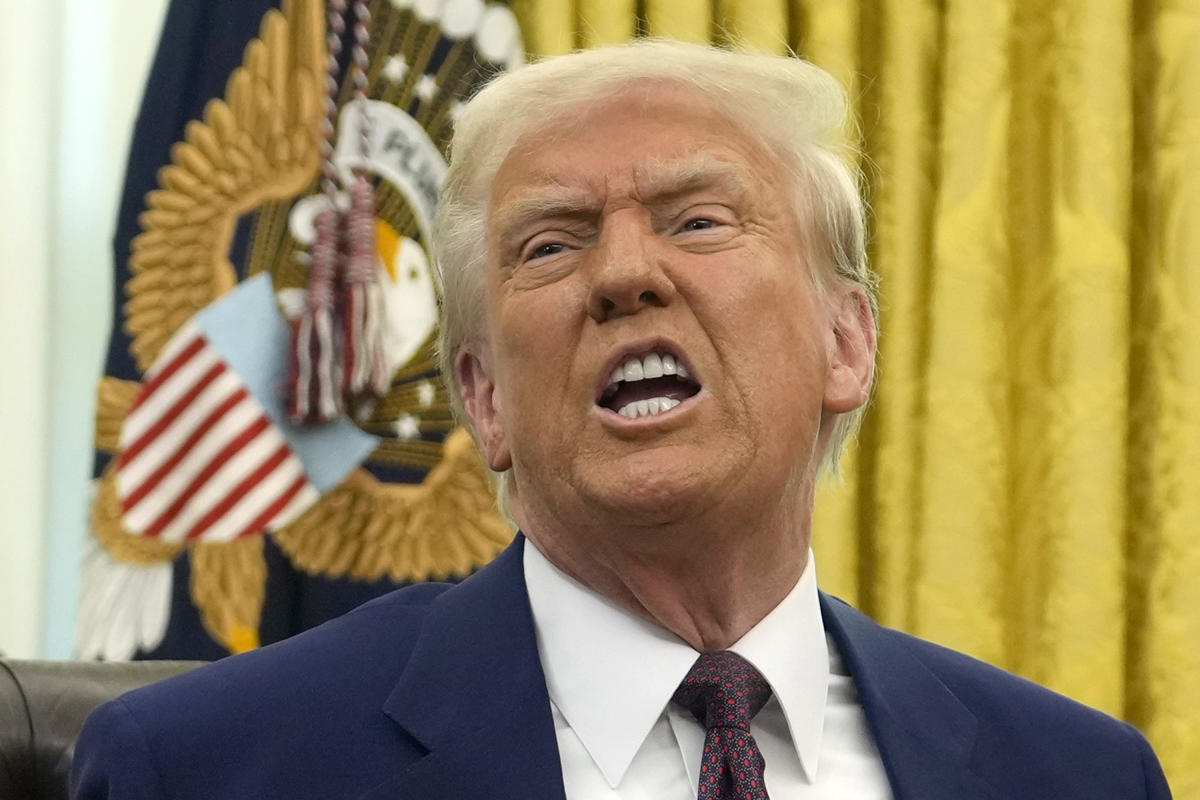
Rate watching: President Donald Trump speaks to reporters in the Oval Office of the White House, where he signed an executive order, Thursday, Feb. 13, 2025, in Washington. (AP Photo/Ben Curtis) ·ASSOCIATED PRESS
Peter Orszag, CEO of investing firm Lazard, argues that other countries seeking to retaliate amid Trump’s trade wars could even use higher rates as a kind of economic weapon. If foreign holders of US debt such as Japan and China wanted to retaliate against Trump’s tariffs, they could sell some of their Treasury holdings, which would push US rates up and force the whole US economy to deal with higher borrowing costs.
“This makes Treasury markets a ripe target if negotiations result in prolonged conflict,” Orszag wrote recently in the Washington Post.
It might all sound a bit fantastical, but so does hiring a tech oligarch with no government experience to right-size a federal bureaucracy that is multiples larger than the biggest corporation. If rates come down and Trump seems satisfied, then it might be a false alarm.
But nobody can be sure what Trump, growing used to getting his way, will do when he meets the resistance of an unmoving market.
Rick Newman is a senior columnist for Yahoo Finance. Follow him on Bluesky and X: @rickjnewman.
Click here for political news related to business and money policies that will shape tomorrow’s stock prices.
Read the latest financial and business news from Yahoo Finance