


Islamabad, Pakistan – When Salima Ahmad* noticed a three-day gap between the expiry of her family’s visas and the date on a document proving that they had applied for renewals, her heart filled with dread. An Afghan citizen living in Pakistan since 2022, Ahmad feared that authorities would arrest her family for residing in the country illegally.
On February 7, just two days after their visas expired, her fears became reality.
A group of police officials, including female officers, raided her rented house, identifying her family as undocumented residents. Despite her pleas and attempts to show that their passports had been sent for visa renewal, the police took her husband away.
“I kept imploring, pleading for his release. I tried to show them my documentation and proof that we had applied for visa renewal, but they didn’t listen,” Ahmad told Al Jazeera.
The policewomen then told Ahmad to pack up her children’s belongings, warning that she would also be taken to a camp for refugees and deportees set up on Islamabad’s outskirts.
“I begged them not to do this. My children would be traumatised. But they eventually put us in a van and took us away,” she said.
After spending two days in a tent at the camp situated in Islamabad’s outskirts, Ahmad only managed to return home two days later by arranging a 60,000-rupee ($216) bribe.
“I had to ask my relatives, who came to check on us, to arrange this loan. Only then were we allowed to go home,” she said. For now, the family has passports back, with visas stamped for one more month, at the end of which Salima fears a repeat of the humiliating and scary experience they endured in early February.
Ahmad’s story is one of many, as thousands of Afghan citizens in Pakistan, many of whom fled following the fall of Kabul to the Taliban in August 2021, now face an uncertain future under a recent government notification.
In a two-page document issued by Prime Minister Shehbaz Sharif’s office last month, the Pakistani government outlined a three-phase plan to send back Afghan citizens living in the country.
The first phase involves the “immediate” deportation of all undocumented Afghan citizens. This includes 800,000 Afghans who did not enter the country on valid visas but who, since 2017, have been granted Afghan Citizen Cards (ACC) by the government of Pakistan itself.
The second phase focuses on Afghan citizens who hold so-called Proof of Registration or PoR cards, first issued in 2006. The final phase will target Afghan citizens who might relocate to third countries.
If the plan is carried out as envisaged, only valid visa holders will remain in the country – none of the other refugees who entered Pakistan under duress without proper documentation will be allowed to stay.
The notification in effect escalates a previously stop-start approach to expelling Afghan refugees. Originally implemented in late 2023, the plan has already led to more than 800,000 Afghan nationals returning to Afghanistan over the past 18 months, according to the United Nations refugee agency (UNHCR).
History of hosting refugees
Pakistan has hosted millions of Afghan refugees since the Soviet invasion of Afghanistan in 1979. Over the next 20 years, as civil war engulfed Afghanistan and the Taliban first took control in 1996, successive waves of refugees arrived in Pakistan.
After the United States invaded Afghanistan in 2001 following the 9/11 attacks, the Taliban’s fall led to the establishment of a civilian government, prompting thousands of Afghans to return home.
Ahmad, who first moved to Pakistan as a seven-year-old in 1997, was among those who resettled in Kabul in 2010. After the family moved, she completed a business degree and started working for Afghanistan’s Ministry of Finance under President Ashraf Ghani.
“I was happily living in Afghanistan at the time. My mother and two sisters relocated to the United States around 2019, but I was comfortable in Kabul,” she said.
However, the Taliban’s stunning return to power in August 2021 triggered another wave of displacement, with between 600,000 and 800,000 Afghans seeking refuge in Pakistan.
Pakistan currently hosts nearly more than 2.5 million Afghans, according to government estimates. Among them, about 1.3 million possess a UNHCR-issued Proof of Registration (PoR) card, first introduced in 2006, while another 800,000 hold an ACC, issued in 2017. All of them, until now, held documents that for all purposes were deemed as certificates of legitimate residence in Pakistan. Now they face an uncertain future under the three-stage “relocation” plan.
Those who arrived after the August 2021 Taliban takeover have had to rely on visa renewals to remain in Pakistan, a process that is expensive, unpredictable and fraught with delays.
While the official visa renewal fee is $20, Ahmad says submitting passports through legal channels often results in prolonged confiscation or outright rejection, putting applicants at risk of detention. So they pay visa agents to expedite the process.
“We have to pay anywhere between 15,000 and 20,000 rupees ($54 to $72) to renew our visas. It used to be valid for six months, but since January this year, the government has only been granting one-month visas,” she lamented.

Strained relations and growing crackdowns
Once considered one of the Afghan Taliban’s closest allies, Pakistan has seen relations with its neighbour deteriorate over the past three years.
Islamabad blames Afghanistan’s Taliban rulers for failing to curb the activities of the Pakistani Taliban, or Tehreek-e-Taliban Pakistan (TTP), a group that emerged in 2007 and has since carried out hundreds of attacks against Pakistani security forces.
In 2024 alone, Pakistan has witnessed more than 500 attacks, resulting in more than 1,500 deaths among civilians and law enforcement personnel.
The Pakistani government has frequently accused Afghan citizens of involvement in these attacks and claims Kabul provides shelter to TTP, a charge the Afghan Taliban denies.
But the government’s recent notification suggests that Afghan refugees now find themselves in the middle of these bilateral tensions.
Afghan citizens holding PoR cards until now have enjoyed some rights, such as the ability to open bank accounts and the chance to register in Pakistan’s citizen database. Now, suddenly, they’re outsiders, and in the queue for expulsion.
In July 2023, following a visit by UNHCR chief Filippo Grandi, Pakistan extended PoR card validity until June 30, 2025. The latest government notification suggests that there is no plan, as of now, to extend their stay any further.
Ikramullah Jamil*, a 31-year-old Afghan citizen born in Pakistan, has lived there nearly all his life, except for six years between 2015 and 2021, when he relocated to Afghanistan with his family.
Jamil and his family had to move out after the Pakistani military launched a major military offensive in the country’s northwestern province of Khyber Pakhtunkhwa, where they used to live.
But after the fall of Kabul, Jamil, the eldest among his eight siblings, chose to return to Pakistan.
“Because of my language skills and connections, I’ve been able to support our Afghan community since 2021. But now, with the government’s vague policies, I fear I could also be at risk of deportation,” Jamil told Al Jazeera.
Even the UNHCR isn’t entirely clear about Pakistan’s plans, said Qaiser Afridi, the spokesperson for the UN agency in Pakistan.
“We are constantly in touch with them [the government] to explain what exactly the plan is, but we have not been given a clear answer,” Afridi told Al Jazeera. “There are several categories of people who are documented and registered as per requirement, so what does the government mean by removing them from Islamabad or Rawalpindi?”
The UNHCR says more than 800 Afghan nationals, including women and children, have already been deported from Islamabad and Rawalpindi since the start of the year.
Praising Pakistan’s “generosity” in hosting millions of Afghan refugees for the past four decades, Phillipa Chandler, the head of the UNHCR in Pakistan, urged the authorities to be more considerate.
“Forced return to Afghanistan could place some people at increased risk. We urge Pakistan to continue to provide safety to Afghans at risk, irrespective of their documentation status,” Chandler said, according to a UNHCR press release.
Looming deadline
The government notification from January has also set a March 31 deadline for Afghan citizens awaiting resettlement in third countries. Those who fail to leave by then risk deportation.
Afridi called the situation “complicated”, noting that thousands of Afghans arrived after August 2021 with legitimate asylum claims or pending resettlement cases.
“There are people whose resettlement cases are still being processed, and others who fear for their lives if they return to Afghanistan,” he said.
Since 2021, nearly 500,000 Afghan nationals have contacted the UNHCR for assistance.
“We have issued documentation to these people; to show they are listed in our system. All we want from the government is to at least recognise this, and to not arrest or deport them,” Afridi said.
Meanwhile, Pakistan’s Ministry of Foreign Affairs earlier this month stated that “almost 80,000 Afghans” have already been resettled in other countries, while 40,000 remain in Pakistan awaiting relocation.
Jamil, currently working for a media outlet, had applied for the US Welcome Corps, a United States government programme for refugees.
“I applied for this programme last year and I even received an email from the State Department that my case will get processed. I had my first interview in December, and I was informed that my settlement process will start in a few days,” he says.
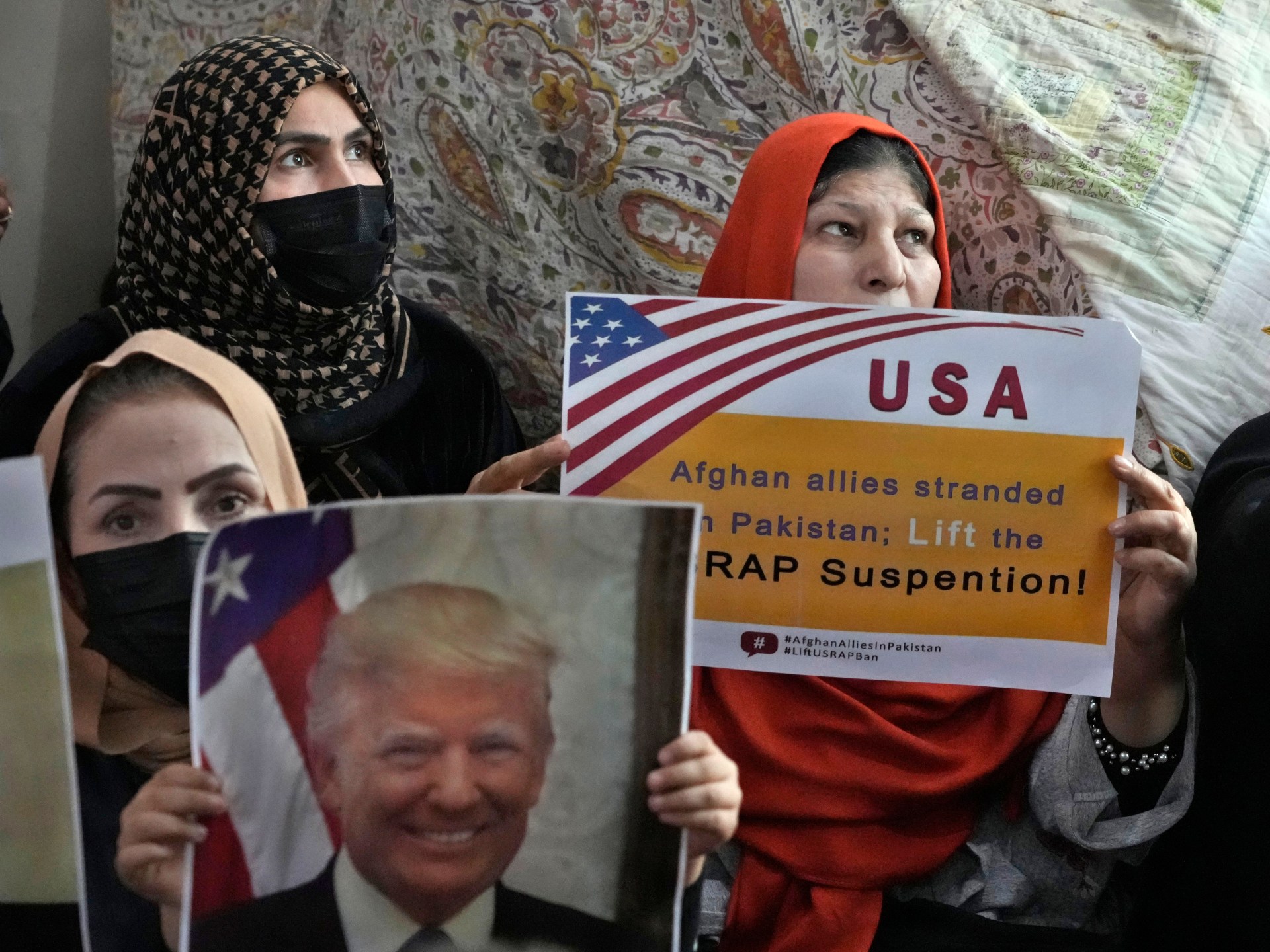
But with the new Trump administration in office, Jamil is unsure what the future holds for him, as the new US president has put a pause on the refugee programme.
“After the new president came in, I was informed that the programme is on hold. I don’t know what will happen to that. Now, my PoR is expiring, and I have no idea what to do.”
Names marked with an asterisk* have been changed to protect identities.
