


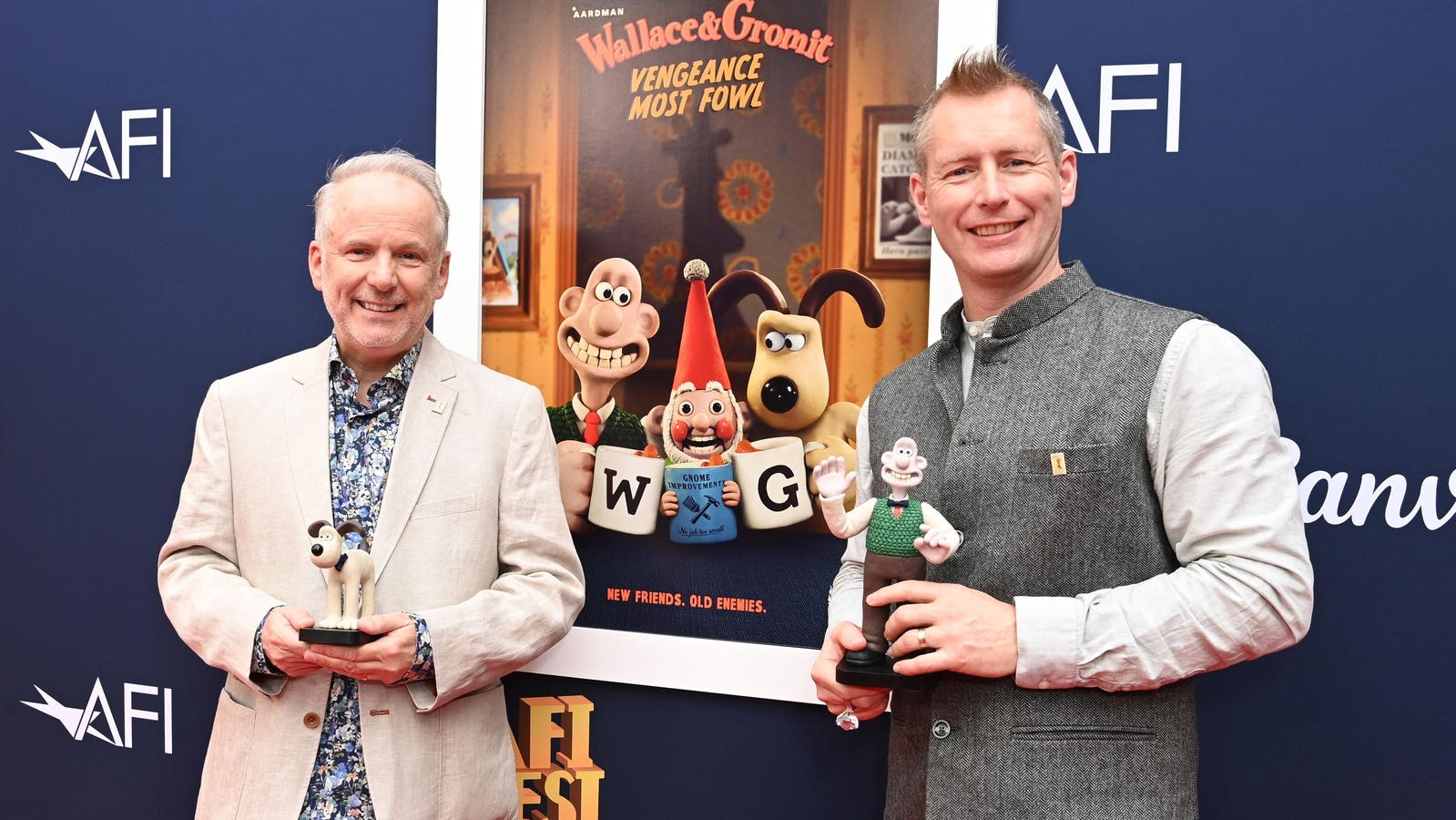
HOLLYWOOD, CALIFORNIA – OCTOBER 27: (L-R) Nick Park and Merlin Crossingham attend AFI FEST 2024 … [+]
Wallace & Gromit: Vengeance Most Fowl’s directors aren’t quite sure what excites them more—an Oscar nomination or Feathers McGraw becoming the new tattoo sensation at home in England.
“The news in the U.K. is he is the No. 1 most requested character tattoo,” Merlin Crossingham, sitting alongside his fellow director, Nick Park, told me in a recent Zoom conversation. “I think that’s quite a commitment, isn’t it? It really is.”
Feathers McGraw, of course, is the shifty penguin villain who first flew into Wallace & Gromit’s orbit in Park and Aardman Animations’ 1993 stop-motion animated film short The Wrong Trousers. In the short, Feathers turns one of Wallace’s (voice of Peter Sallis) inventions against him to steal a large priceless diamond until Gromit saves the day.
Now, in Wallace & Gromit: Vengeance is Most Fowl—which is streaming exclusively on Netflix—Feathers McGraw hacks into and reprograms Wallace’s latest invention, a robotic garden gnome named Norbot, to help him bust out of prison and steal the massive diamond once more. Worse yet, Feathers frames Wallace (voice of Ben Whitehead) for the crime.
Naturally, Park and Crossingham are thrilled with their Best Animated Feature Oscar nomination for Wallace & Gromit: Vengeance Most Fowl, but in all sincerity, stories like the Feathers McGraw tattoo boom make them feel like winners already.
“That’s the aim, isn’t it? It’s the stories. It’s like the characters exist,” Park said. “That’s what a good story does. It make people believe that the characters exist outside of the story after the film finishes and after the credits, and they carry them on in their minds and in their hearts.”
Feathers McGraw in “Wallace & Gromit: Vengeance Most Fowl.”
How The Timing Was Finally Right For Feather McGraw’s Return
Even though he’s heard inquiries over the years about bringing back Feathers McGraw to Wallace & Gromit’s world, Nick Park said never looked for a reason to wedge the diamond thief into another of of the duo’s films simply because “never really a context or a reason to do it.”
Something changed, however, when the story that eventually became Vengeance Most Fowl began to develop.
“[We were] playing around for years with the idea of Wallace inventing a robot to help Gromit in the garden,” Park said. “We were tinkering around with that idea for a long time as a 30-minute short, but there was just that lack of something sinister going on behind it all, like if machines were going to go wrong.”
Then, Park added, an idea jolted in “like a lightning flash.”
“We thought, ‘Wow, this would be the perfect place to bring back Feathers McGraw,’” Park said. “It was a solution to the story and a decision to do a sequel with him.”
Perhaps the most challenging aspect of bringing Feathers back into the fold in Vengeance Most Fowl was, like in The Wrong Trousers, keeping the villainous penguin a silent character with very little body language to convey his emotions or actions.
Luckily, Park had the experience of working with the character before to establish his foundation.
“It starts back at The Wrong Trousers when Steve Box animated Feathers McGraw for me … and we carried that [idea] through onto [Vengeance Most Fowl],” Park said. “It was about trusting in the simplicity of something.”
“[It was about] holding back and making him enigmatic and mysterious and not overdoing it,” Merlin Crossingham added. “Less is more is very much a mantra for feathers.”
By allowing Feathers’ silence to communicate his emotions and motivations, it gave the stakes for Vengeance Most Fowl “more of a cinematic quality,” Park said. “He has more of a presence in that way, like a fine actor in a thriller; where you’ve got [somebody akin to] the evil Hannibal Lecter or the Godfather, where they do so little, really, and the audience reads everything into their little gestures.”
And with Feathers, there’s no question that his gestures are very little.
“Gromit, just from a performance standpoint has eye pupils that can look [around]. He’s got shoulders [he can shrug]. You can give him give him a quite eloquent physical performance,” Crossingham explained.
“Feathers doesn’t do that. His eyes don’t move and they’re solid black. He’s got some flippers, but he doesn’t really perform with them. He occasionally will move his head a little bit and when he moves, it’s more of a glide than a walk,” the filmmaker added. “So, he is hugely restricted and those restrictions make you think about his physical performance even more.”
Crossingham noted that even Feathers’ eye blinks were something he and Park had to make decisions about.
“We’d scrutinize and debate about when he should blink, if he should blink and ‘Should it be once? Should it be twice? Should it be none at all?’”Crossingham recalled. “Even those kinds of decisions are critical to making him have screen presence.”
Merle Crossingham and Nick Park on the set of “Wallace & Gromit: Vengeance Most Fowl.”
What’s Behind The Oscars’ Love For Stop-Motion?
The history of Wallace & Gromit is, to say the least, long and illustrious. Nick Park first brought the stop-motion dynamic duo to life in 1991 with the Oscar-nominated short A Grand Day Out, only to lose to himself in the Best Animated Short category with Creature Comforts.
The Wrong Trousers then earned Park his second Oscar, which was followed by another Wallace & Gromit short, 1995’s A Close Shave, which earned the filmmaker his third Academy Award.
Park returned to the Academy Awards stage once again with his lovable pals—but in the form of a full-length movie—in 2005’s Wallace & Gromit: Curse of the Were-Rabbit, which earned the filmmaker and his fellow Aardman director Steve Box a Best Animated Feature Oscar.
However, Park’s work was far from over, as he brought Wallace & Gromit back with another Oscar-nominated film short—A Matter of Loaf and Death—in 2008.
Gromit, Norbot and Wallace (voice of Ben Whitehead) in “Wallace and Gromit: Vengeance Most Fowl.”
The heartening thing is, the Oscars’ apparent love for stop-motion animation doesn’t begin and end with Aardman’s films. Tim Burton’s Corpse Bride and Frankenweenie also earned Best Animated Feature Oscars, as have all five of Laika’s feature films: Coraline, ParaNorman, The Boxtrolls, Kubo and the Two Strings and Missing Link.
In addition, both of Wes Anderson’s stop-motion films—The Fantastic Mr. Fox and Isle of Dogs—were nominated for Best Animated Feature by the Oscars, as was Duke Johnson and Charlie Kaufman’s Anomalisa. More recently, Guillermo del Toro’s Pinocchio won the Best Animated Feature Oscar.
But that’s not all. In addition to Wallace & Gromit: Vengeance Most Fowl, writer-director Adam Elliott’s stop-motion film Memoir of a Snail is up for the Best Animated Feature Oscar this year.
Park and Merlin Crossingham can’t exactly explain why the Academy of Motion Picture Arts & Sciences has an affinity for stop-motion, but they have their guesses.
“The Academy still seems to have time for the age-old authenticness [of stop-motion] amongst all the wonderful CGI films,” Park observed. “There’s still a place I think in their hearts for the old. There are a lot of animators and people in the industry who seem to feel the warmth of the old and the handmade-ness of things.”
Plus, Crossingham added, before computer animation, filmmakers—unless they were hand-drawn animators—relied on “stop-motion for practical and physical visual effects, which is very similar to the world in which we move in.”
“There’s an element of the craft, the authenticity of having a real set, albeit miniatures, and real characters and we’re using real lights. It’s people making films,” Crossingham noted. “I think that that’s one of the things that resonates.”
Wallace & Gromit: Vengeance Most Fowl is streaming exclusively on Netflix.
