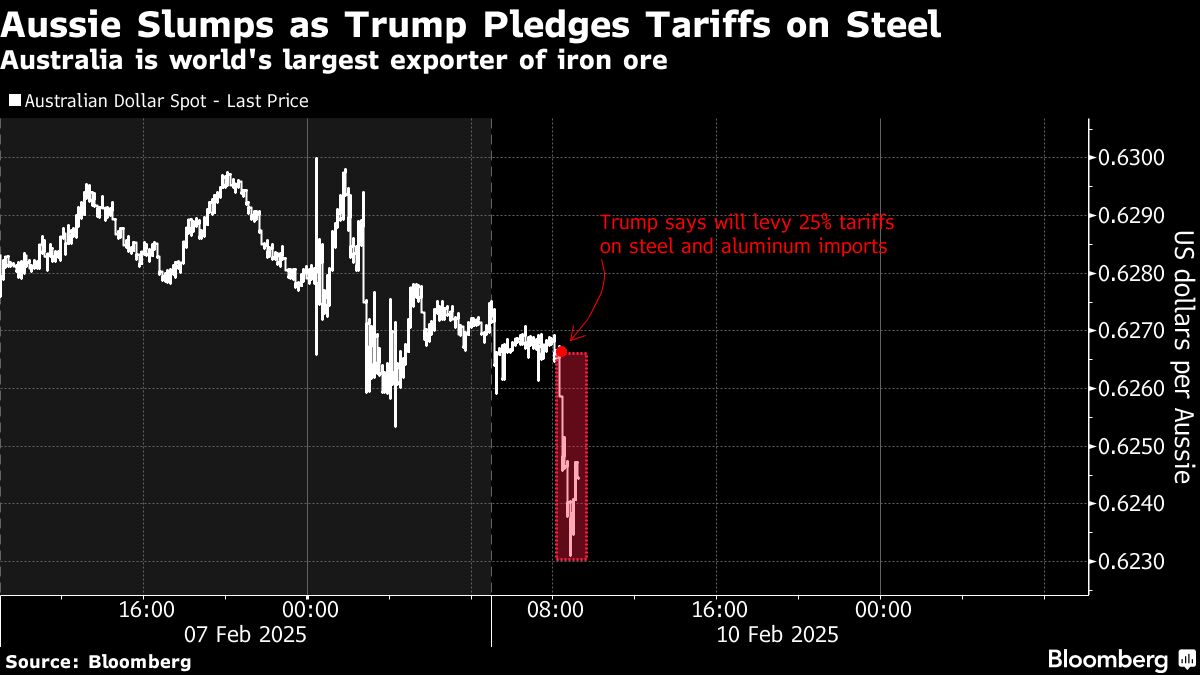
(Bloomberg) — President Donald Trump’s pledge to impose tariffs on all imports of steel and aluminum pushed commodity currencies and Asian equities lower as markets remained jittery about trade tensions. Hong Kong stocks were an outlier.
Most Read from Bloomberg
The Australian and Canadian dollars, and the Norwegian krone, all weakened following Trump’s comments. A benchmark of Asian equities fell for the first time in a week, while gold edged up toward a record as investors shunned risk.
Trump’s intention to announce a 25% levy on steel and aluminum Monday added to already tense sentiment before Federal Reserve Chair Jerome Powell’s semiannual congressional testimony and the US President’s possible unveiling of reciprocal tariffs on “everyone” this week. Trump said the metals tariffs would apply to imports from all countries, though he didn’t specify when they would take effect.
“Markets continue to react to Trump policy shifts rather than economic data,” Bob Savage, head of markets strategy and insights at BNY, wrote in a note to clients. “The take from Fed Chair Powell will be critical in judging the costs of tariffs and other policy shifts on easing plans.”
Futures for S&P 500 and Nasdaq edged higher in Asian trading. US Treasury yields dipped.
Separately, Trump said Elon Musk’s government efficiency team has found irregularities while examining data at the US Treasury Department.
Powell will deliver his semi-annual testimony at a time when officials are signaling they’re not in a hurry to further ease policy. Nonfarm payrolls moderated last month and revisions show US job gains were softer but still solid in 2024. Inflation data due this week may help buttress those arguments and underpin market pricing for just one Fed rate cut this year.
In Singapore, shares in DBS Group Holdings Ltd. rose to a record after Southeast Asia’s biggest lender unveiled an investor payout plan.
Shares in Hong Kong and mainland China bucked the trend and advanced. The Hang Seng Tech Index hit its highest since October on an intraday basis, as the growing artificial intelligence clout of the world’s second-largest economy sparked a wave of optimism.
Shares of Chinese e-commerce platform operators climbed as Trump delayed suspension of the de minimis exception, temporarily retaining duty free status for low-value packages coming from the Asian country. That was after the United States Postal Service last week paused — and then resumed — accepting shipments from China and Hong Kong as officials grappled with how to implement the new US tariffs
“We have a relatively positive view of risk assets,” though positions have been trimmed due to financial market volatility, Jin Yuejue, a multi-asset solutions investment specialist at JPMorgan Asset Management, told Bloomberg Television. “There are still interesting stories in the China market,” as some companies excel at technological innovation.
Commodities were muted as traders waited for more details on when and how Trump’s latest tariffs would operate. Aluminum futures in London — the global benchmark — were slightly weaker at $2,619.50 a ton, while copper was little changed.
Elsewhere, South Africa’s rand fell in early trading after the US froze all aid to the nation over what Trump falsely claimed were rights violations stemming from a new land-expropriation law, as well as its allegations of genocide against Israel. South Africa’s foreign ministry in a statement Saturday expressed “great concern that the foundational premise of this order lacks factual accuracy.”
Some key events this week:
China’s retaliatory tariffs on US goods are scheduled to take effect, Monday
ECB President Christine Lagarde testifies to European Parliament, Monday